The HUB Bridgehampton gallery · artist spotlight
Perfectly Broken: Sebastian “Bastian” MOPA’s Glass Gardens & Mirror Seas Discovering The Beauty of Fragments
A four-foot floral queen portrait and a pairing shimmering aquatic underwater dreamscape show how the Colombian-born artist MOPA turns broken glass, mirror, and crystal fragments into messages of kindness and harmony using painted color, reflective materials, & sculptural detailed richly imagined worlds.
Visit The HUB · At 10AM-6PM — Wednesday To Sunday · 2183 Montauk Highway, Bridgehampton, NY 11932
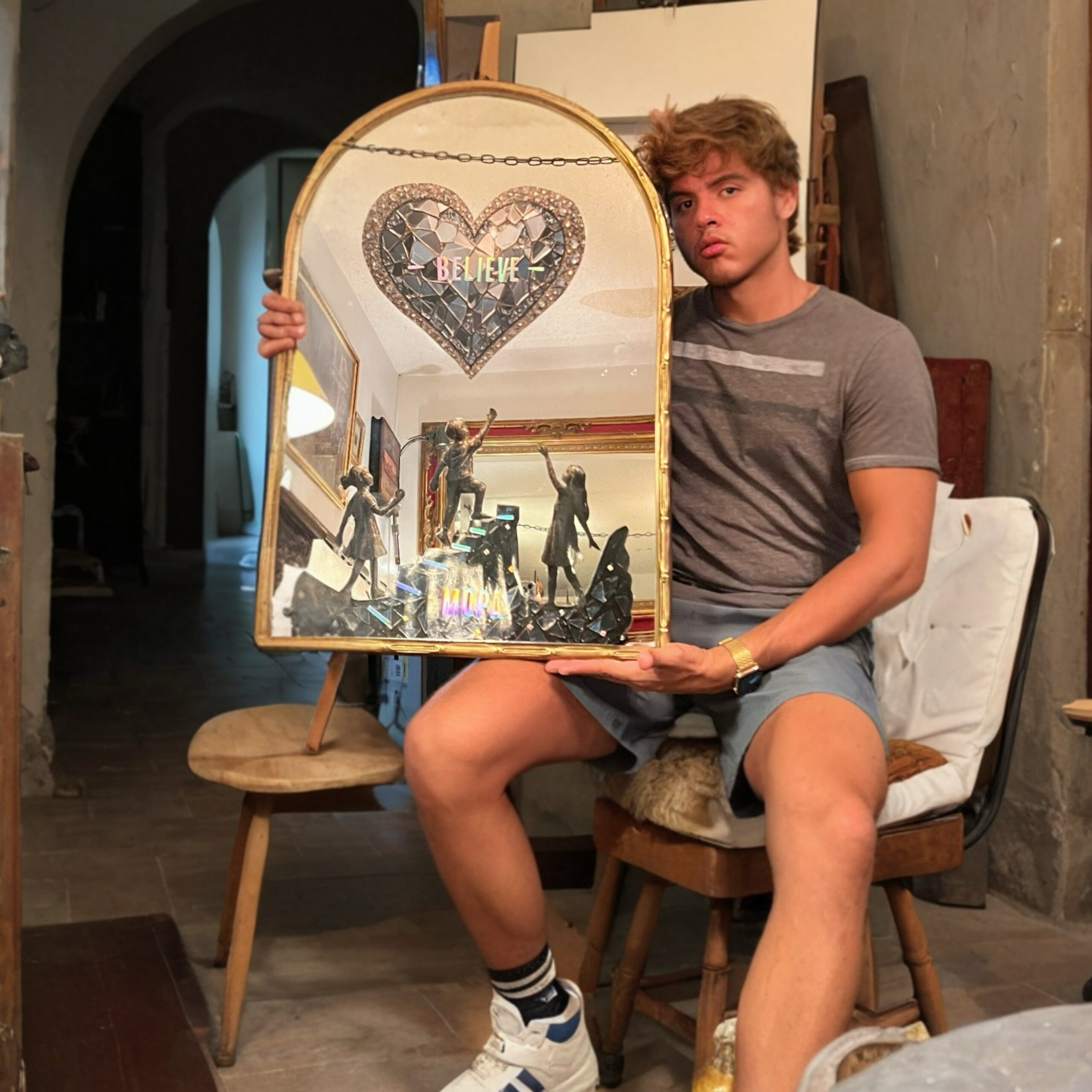
Sebastian “Bastian” MOPA builds with what has been broken. Shards of glass, fragments of mirror, and scattered crystals are set into resin, where they become petals, waves, and points of light. In Sebastian MOPA’s work, looking closely means discovering how an image is put together. A flower resolves into individual colored pieces. A pale shape becomes a shell. A mirrored edge catches light differently from the painted surface beside it. Two works represent him at The HUB. The Garden is a 48-inch-square portrait of a woman crowned in flowers. The Two Oceans is a 21-by-17-inch canvas where two blues flow side by side, carrying shells, coral, and butterflies in their current. Both share a visual character that is hard to capture in a photograph: glitter, gloss, and reflection. Mirror and crystal catch whatever light the room offers, so the surfaces shift as you move. Pop-art clarity meets the natural world, and every piece arrives with a message attached. What makes these works compelling is their central paradox: each piece is built from fragments, and each one is about becoming whole.
The Artist’s Creative Approach
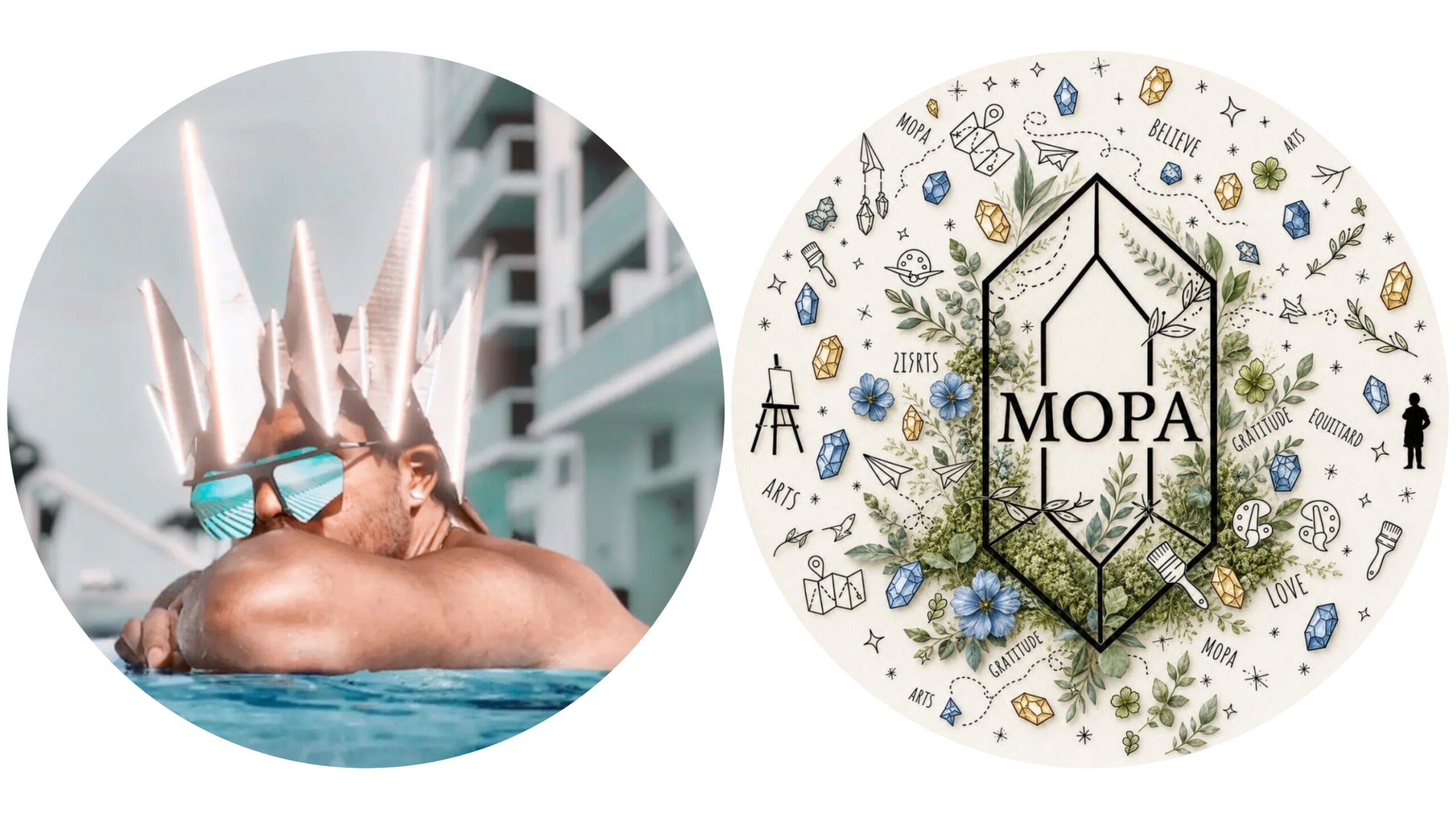 Born Sebastian Mora in Medellín, Colombia, in 1991, the artist works under the name MOPA. His early years were marked by loss: his mother died when he was two, and his father was not part of his life. In his grandmother’s care, he discovered that he could create the love he felt was missing. He moved to Miami in 2006 and developed the signature approach seen at The HUB: broken glass, mirror, and crystals mixed with resin. The method carries his central idea of being perfectly broken — flawless on the surface while holding the memory of what was shattered beneath. His mission has two parts: to make unique pieces that bring happiness and joy, and to build a brand that helps others in need. His guiding principle is simple: Do everything with love. Beyond gallery works, his practice extends to pop art, painted boards, briefcases, designs & coasters. That outlook informs his choice of materials. MOPA describes combining broken glass, mirror, and crystals with resin, arranging fragments into figures and portraits. He connects this process to the idea that something fractured can still possess beauty, describing it as “perfectly broken.” The two works at The HUB make this approach tangible through different compositional choices. In The Garden, fragments accumulate into a floral crown around a clearly defined face. In The Two Oceans, individual objects remain more widely spaced, allowing the surrounding color to suggest currents and depth. The placement of each element determines how the larger image unfolds.
What to look for in these works
- Fragments as brushstrokes. Pieces of glass and mirror are placed like mosaic tiles, building color one shard at a time.
- Resin as glaze. A glossy resin surface seals everything together, deepening color and giving the work the look of water or glass.
- Light as a material. Mirrors and crystals make the room’s light part of the composition.
- A message in every piece. Each work is paired with a written intention — kindness, harmony, individuality.
A Closer Look At The Featured Works
The Garden: The Sovereign of Floral Life
Acrylic, crystals, mirrors, glass, and resin on wood · 48″ × 48″ · Listed at $12,360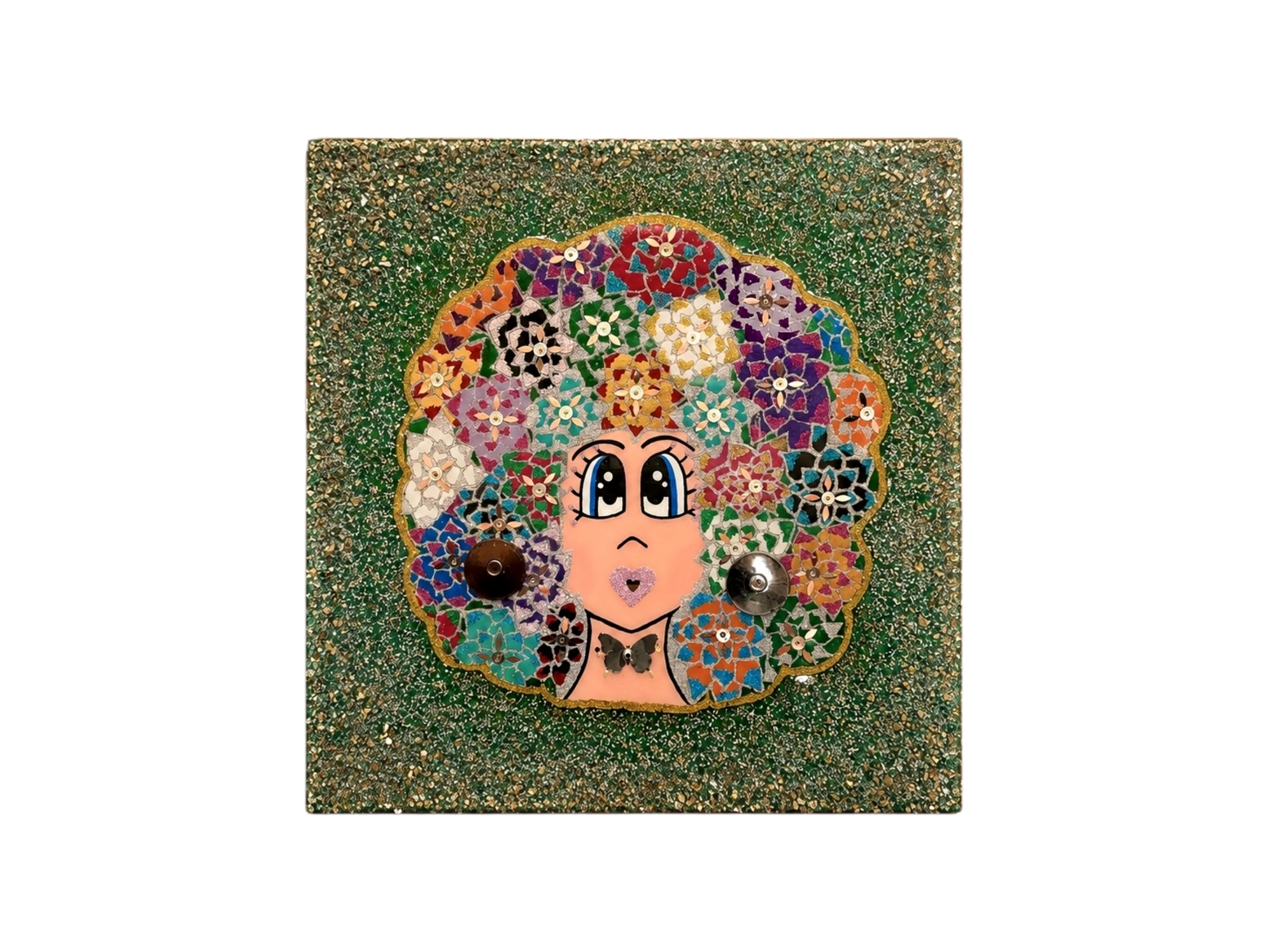
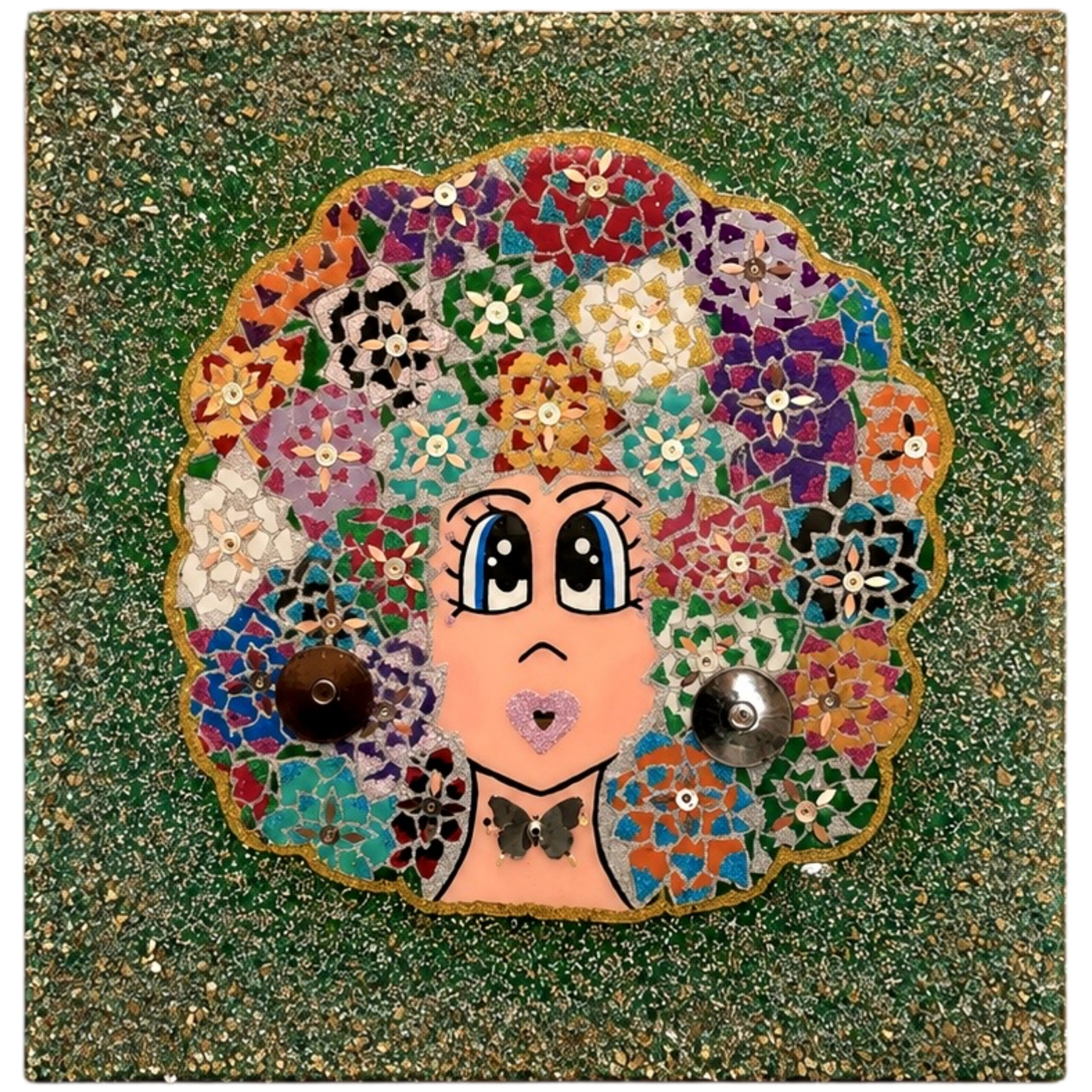
A peach-toned face sits within a generous crown of flowers, set against a densely textured green field flecked with gold. The square format gives the composition a stable perimeter, while the rounded floral silhouette creates a softer shape within it. Large, upward-looking eyes establish the focal point; a small heart at the lips and a butterfly at the neck reward a second look. The crown is built through an abundance of separate color areas. Red, purple, turquoise, orange, green, and white form petals and clustered blooms, their irregular fragments contained within recognizable floral patterns. Small circular centers punctuate the arrangement. Larger reflective discs on either side of the face introduce a different scale and a more concentrated flash of light. The contrast between the smooth-looking face and the fragmented crown is central to the work. The figure’s clear outline keeps the expression legible amid the surrounding detail. Meanwhile, the green background establishes a quieter color family without becoming an empty field: its many small reflective pieces extend the work’s visual activity beyond the flowers. The gallery’s description associates the flower-crowned figure with kindness and speech guided by love. The heart-shaped mouth gives that idea a precise visual anchor. In this reading, the garden becomes a metaphor for what care can cultivate, with the expanding crown suggesting a world brought into bloom around the figure. MOPA’s own text tells her story: a woman whose kingdom blossomed from a single flower, and who became, through patience, grace, and devotion, the sovereign of all floral life. At four feet square, she arrives larger than life.
- The crown: Her hair is a vast rounded bloom of mosaic flowers in purple, pink, blue, orange, green, and patterned black and white. A point of crystal sparkles at the center of each blossom, and a gold line traces the outer edge.
- The face: By contrast, her features are clean and graphic — a soft peach complexion, oversized blue eyes with sweeping lashes. The simplicity lets the crown do the talking.
- The heart: A small glittering pink heart rests on her lips. In the artist’s words, it is a reminder that speaking with love plants the seeds of the most beautiful dreams.
- Small details: A dark butterfly sits at the base of her neck, and two round metallic discs at either side of her head read like statement earrings.
- The ground: A deep green field, textured and flecked with gold and crystal, surrounds her like a sunlit lawn.
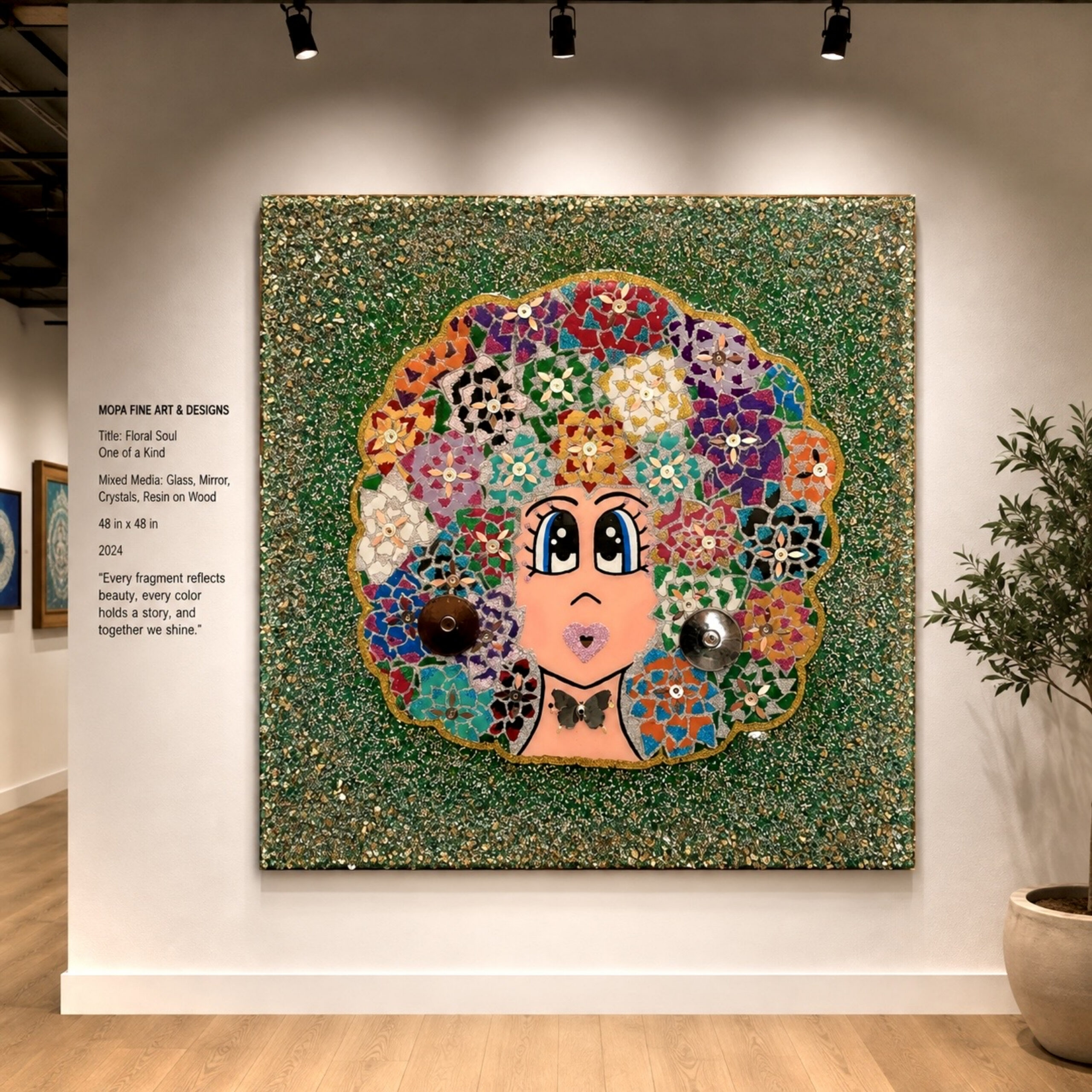
Interpretation: MOPA frames kindness as a kind of power — the power to transform the world with every gentle touch. Visually, the idea is literal: she is not standing in a garden; she is the garden. And her crown, assembled from broken pieces, may be the clearest picture of what the artist means by perfectly broken.
The Two Oceans: Two Blues, One Current
Acrylic, crystals, mirrors, glass, and resin on canvas, with seashells, coral, and organic elements · 21″ H × 17″ W · Listed at $5,150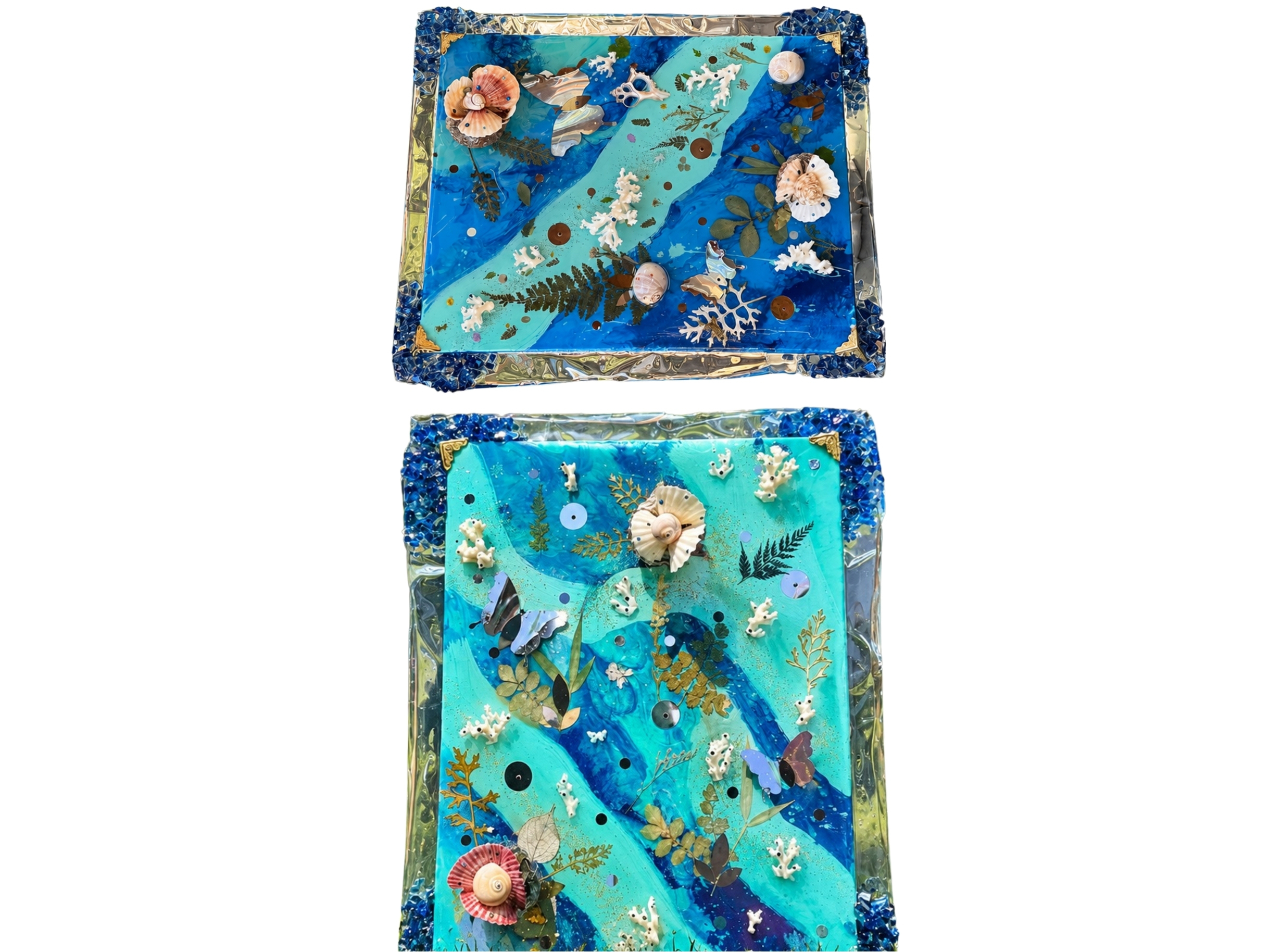
In The Two Oceans, turquoise, aqua, and deeper blue move through two rectangular compositions. Broad diagonal passages establish a sense of flow before the eye begins to register the smaller elements. The photographed pairing contrasts a horizontal arrangement with a vertical one, giving related colors and forms different directions in which to travel. Shells, pale branching coral forms, fern-like leaves, and butterfly shapes occupy the colored fields. Some cluster into small arrangements; others sit apart, surrounded by blue. This spacing allows individual objects to retain their identities while contributing to a larger aquatic atmosphere. Raised details introduce physical depth, while the contrast between pale accents and darker passages creates a second, pictorial sense of depth. The borders also participate in the composition. Reflective edging and concentrations of blue fragments turn the perimeter into an active surface. Their irregular texture answers the scattered details within, creating continuity between the interior and the frame-like boundary. The result asks the viewer to follow both the broad movement of color and the much smaller routes between objects. The gallery describes the work in terms of distinct worlds connected through nature, reflection, and transformation. Visually, that relationship rests on shared materials without identical arrangements. The two compositions belong together through their palette and recurring forms, while each maintains its own balance of open space, directional movement, and detail. Where The Garden is a portrait, The Two Oceans is a place — an underwater dreamscape that invites close, patient looking.
- Structure: Diagonal bands of deep cobalt and bright turquoise run side by side across the canvas. These are the two oceans of the title — distinct, yet flowing in the same direction.
- Suspended treasures: Scallop shells, branching white coral, ferns and leaves, round sequin-like discs, and lavender butterflies seem to float within the glossy resin.
- The edge: A crinkled, mirror-bright silver border wraps the canvas, with clusters of blue crystal gathered at the corners. The frame is part of the artwork, not an afterthought.
- Light and depth: Under the resin, the blues gain the depth of water, while mirror and crystal flash like sunlight on the surface.
- Scale: At 21 by 17 inches, it is intimate enough to reward a close look — each shell and leaf is a small discovery.
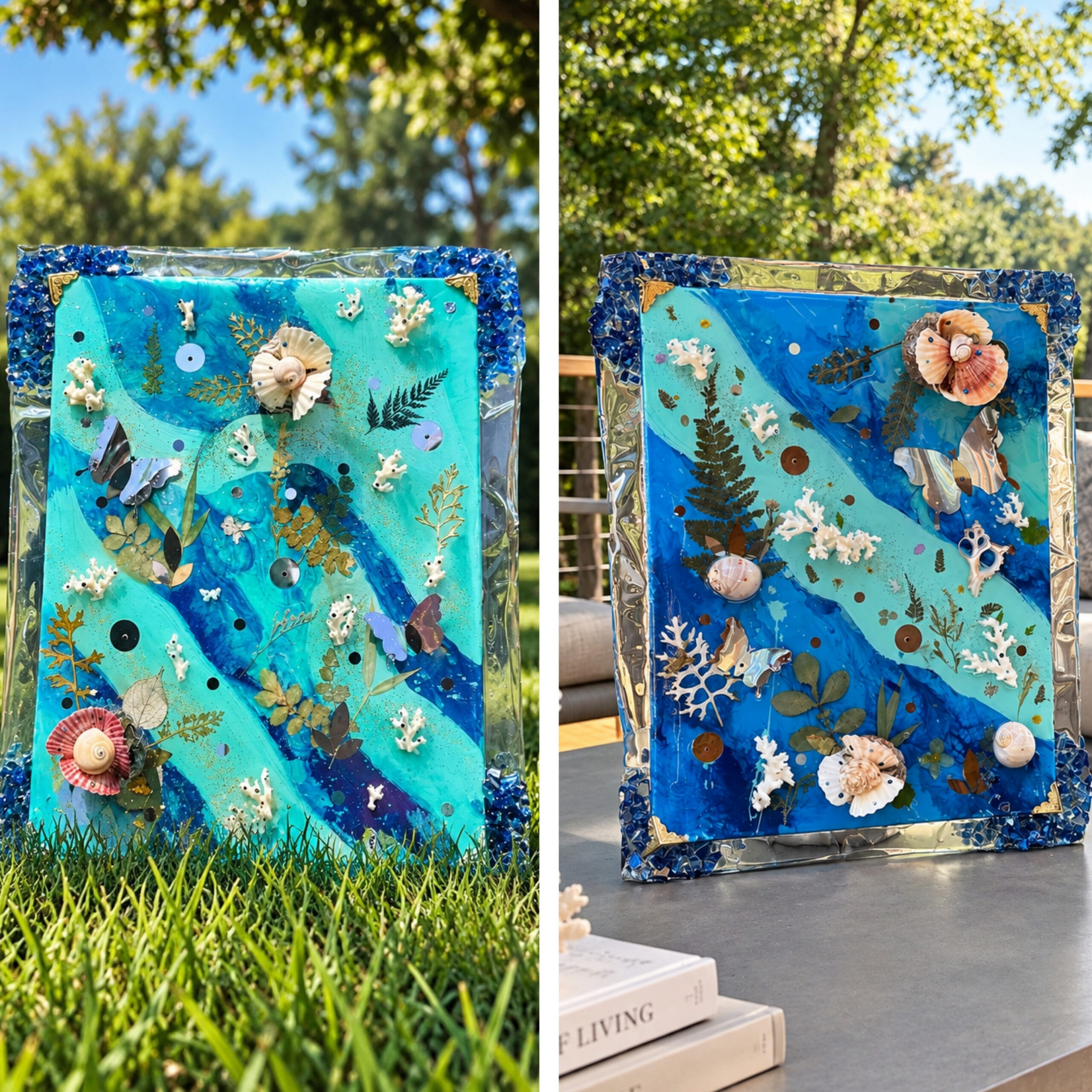
Interpretation: MOPA describes the piece as a celebration of individuality and a reminder that, like the oceans, we are all part of something greater. Notice, too, that butterflies and ferns belong to the air and the land. Their presence underwater turns the scene into a dream where every world meets.
Connections Across the Works
Nature gives both works a way to organize many separate elements. In The Garden, the repeating logic of petals gathers fragments into a crown. In The Two Oceans, branching forms, shells, and flowing bands of color create a looser network of relationships. One leads attention toward a face; the other encourages the eye to wander among several points of interest. The fragment remains visible even as it becomes part of a larger whole.That relationship is especially meaningful in the context of MOPA’s stated approach to broken materials. The pieces retain their individual edges, colors, and reflective qualities. Their unity comes through arrangement. Seen together, the works show how a closely gathered portrait and a more open aquatic composition can express that idea with very different moods: floral exuberance in one, a sense of drifting discovery in the other. Side by side, the two works read like opposite halves of one worldview.
- Fragments made whole. Both are built from the same vocabulary of glass, mirror, and crystal under resin. The material itself carries the artist’s story.
- Land and sea. One work blooms; the other flows. Together they cover the two great subjects of the natural world — and a butterfly appears in both, a quiet thread between them.
- Figure and field. The Garden is centered and symmetrical, with a single face holding the composition. The Two Oceans has no figure at all; its energy runs on the diagonal, from corner to corner.
- Warm and cool. A multicolored crown on deep green meets a palette of cobalt, turquoise, and silver.
- Statement and secret. At 48 inches square, The Garden commands a wall. At 21 by 17 inches, The Two Oceans draws you in to discover its details.
- Love as the through-line. One piece speaks of kindness, the other of harmony and individuality. Both carry the same guiding principle: do everything with love.
In MOPA’s work, what was broken is never hidden — it is what catches the light.

See Sebastian MOPA in Person
Mirror and crystal are made for moving light, and no photograph can quite capture them. Stand in front of The Garden, take a step to one side, and watch the crown come alive. Explore The Garden and The Two Oceans at The HUB Bridgehampton Art Gallery. Their overall compositions make an immediate impression, while closer viewing brings the small fragments, reflective surfaces, and dimensional details into focus. Visit the gallery, browse the complete Sebastian MOPA collection, or email us to inquire about either featured work.
Location: The HUB, 2183 Montauk Highway, Bridgehampton, NY 11932
Hours: 10:00 a.m. – 6:00 p.m., Closed Monday- Tuesdays
Admission: Complimentary
Inquire About Sebastian MOPA Artwork →
Explore the Full Collection →
The collection at a glance
- The Garden · 48″ × 48″ $12,360
- The Two Oceans · 21″ × 17″ $5,150
Discover more of the artist’s work at mopaarts.com.