
The HUB × Art Hampton · Bridgehampton
Every Surface a Face: Peter Robert Keil at The HUB Bridgehampton
Portraits of Warhol & Picasso share the room with a painted chair, two original skateboards, and a hot-pink suitcase — eight works that show how the “Wildman of Berlin” turns anything he touches into a face. Expressive portraits meet skates, furniture, & luggage in a collection that carries the painted face beyond a frame.
Visit The HUB · At 10AM-6PM — Wednesday To Sunday · 2183 Montauk Highway, Bridgehampton, NY 11932
Give Peter Robert Keil a surface and he will find a face in it. A canvas, certainly — but also the seat of a chair, the deck of a skateboard, the shell of a suitcase. The eight works gathered at The HUB show both sides of that impulse. Four are portraits of artists: three named for Andy Warhol & a pair dedicated to Pablo Picasso. Four are everyday objects transformed: a longboard, a skateboard, a white wooden chair, and a case of vivid pink luggage. Across all eight, the language is unmistakably his: thick black contour lines, blocks of saturated, unblended color, and oversized, watchful eyes. Features slip, overlap, and rearrange themselves, yet each face keeps a distinct personality. A face can hold an entire composition together. In Peter Robert Keil’s work, enlarged eyes, sweeping outlines, and unexpected color make that face an active presence. It can fill a framed picture, stretch along a skateboard, or look up from the seat of a chair. In his hands, a portrait is less a likeness than a burst of feeling — and almost any object can hold one.
The Artist’s Creative Approach
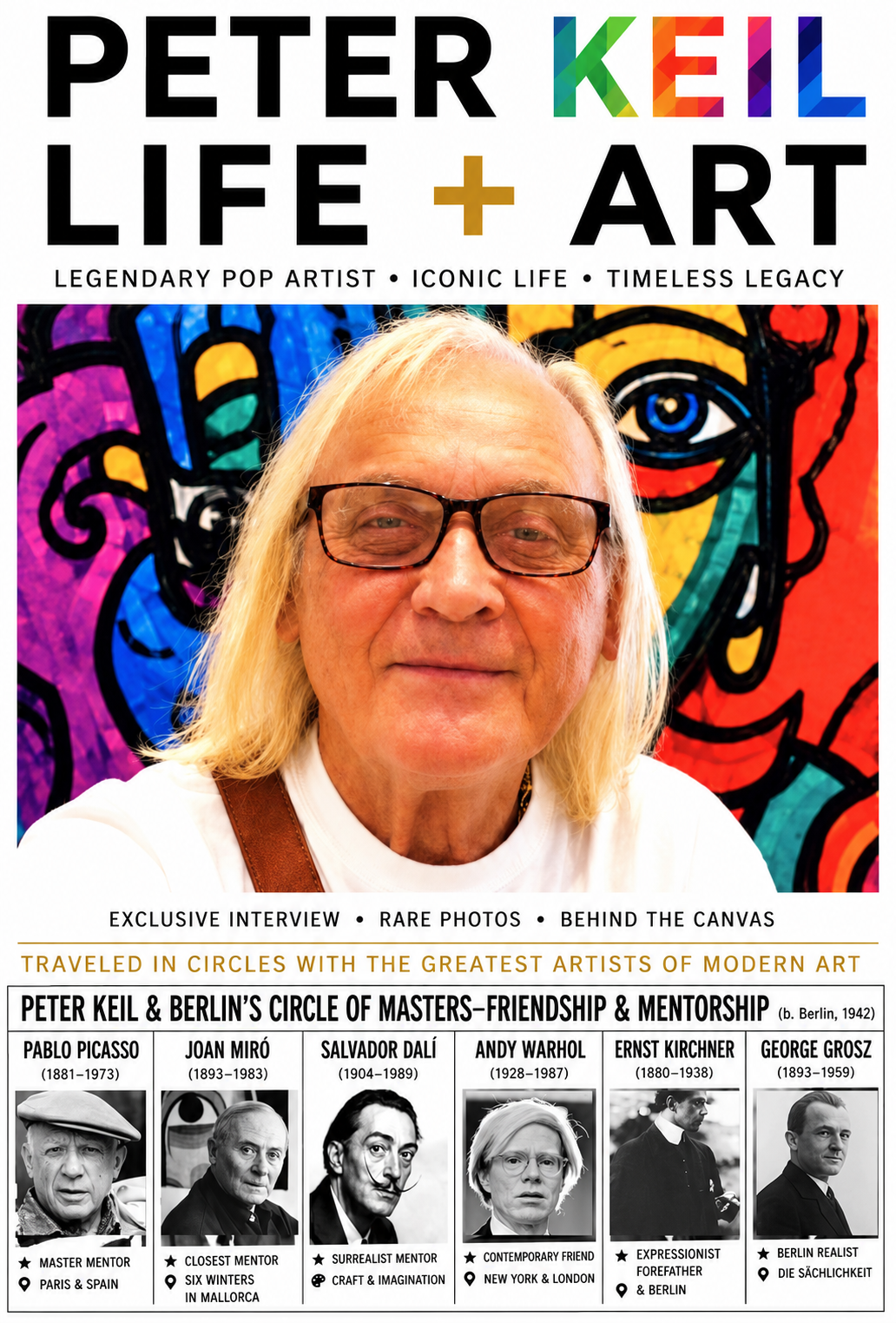
Peter Robert Keil was born in August 1942 in Züllichau, Pomerania, now part of Poland. After his father was killed on the Eastern Front, he and his mother moved to West Berlin, where he grew up among grey apartment blocks. As a boy he discovered Expressionist painting in library books — Picasso above all. He studied and copied the master’s style, and later met Picasso in Spain. At 15 he met the painter Otto Nagel, who became his first teacher and mentor. In his own account of his practice, Keil points to German Expressionism and describes moving away from realistic representation toward more spontaneous, dynamic painting. Quick brushwork, heightened color, and graffiti elements form part of that account, alongside a practice encompassing paintings, sculpture, and objects. The featured works make that freedom easy to see. Black contours establish the image; color changes its emotional temperature. Features shift in scale, and patches of red, green, yellow, or blue need not follow the boundaries of a naturalistic face. Across the objects, the shape of the support becomes another compositional decision. At Berlin’s Academy of Fine Arts he crossed paths with Baselitz, Fetting, Lüpertz, and Schönebeck. In the early 1960s he formed a close friendship with Joan Miró, whom he met in Mallorca and who repeatedly invited him to his studio in Palma. In Paris, from a small studio near the Place de la Bastille, he painted portraits in cafés and bars. His passion for art, living, and lively conversation earned him the name the Wildman of Berlin. His paintings from those years are now regarded as a visual record of the early phase of West German neo-expressionism. Today his son Benjamin Keil leads the official art brand.
What to look for in these works
- Contour first. Heavy black lines hold every face together — and often the whole composition.
- Color as structure. Faces are divided into flat zones of green, yellow, orange, blue, or red. The color doesn’t describe skin; it maps mood.
- The eyes. Oversized, heavily outlined, and alert, they are the anchor of nearly every face.
- An open hand. Brushwork and line stay loose and visible, so the act of painting becomes part of the expression.
A Closer Look at the Featured Works
The collection falls naturally into two groups: portraits of the artists Keil holds dear, and everyday objects he has turned into portraits.
Part I · Portraits of Artists
Andy Warhol My Dear Friend: A Restless Face in a Gilded Frame
Painting in an ornate gold frame · Listed at $7,725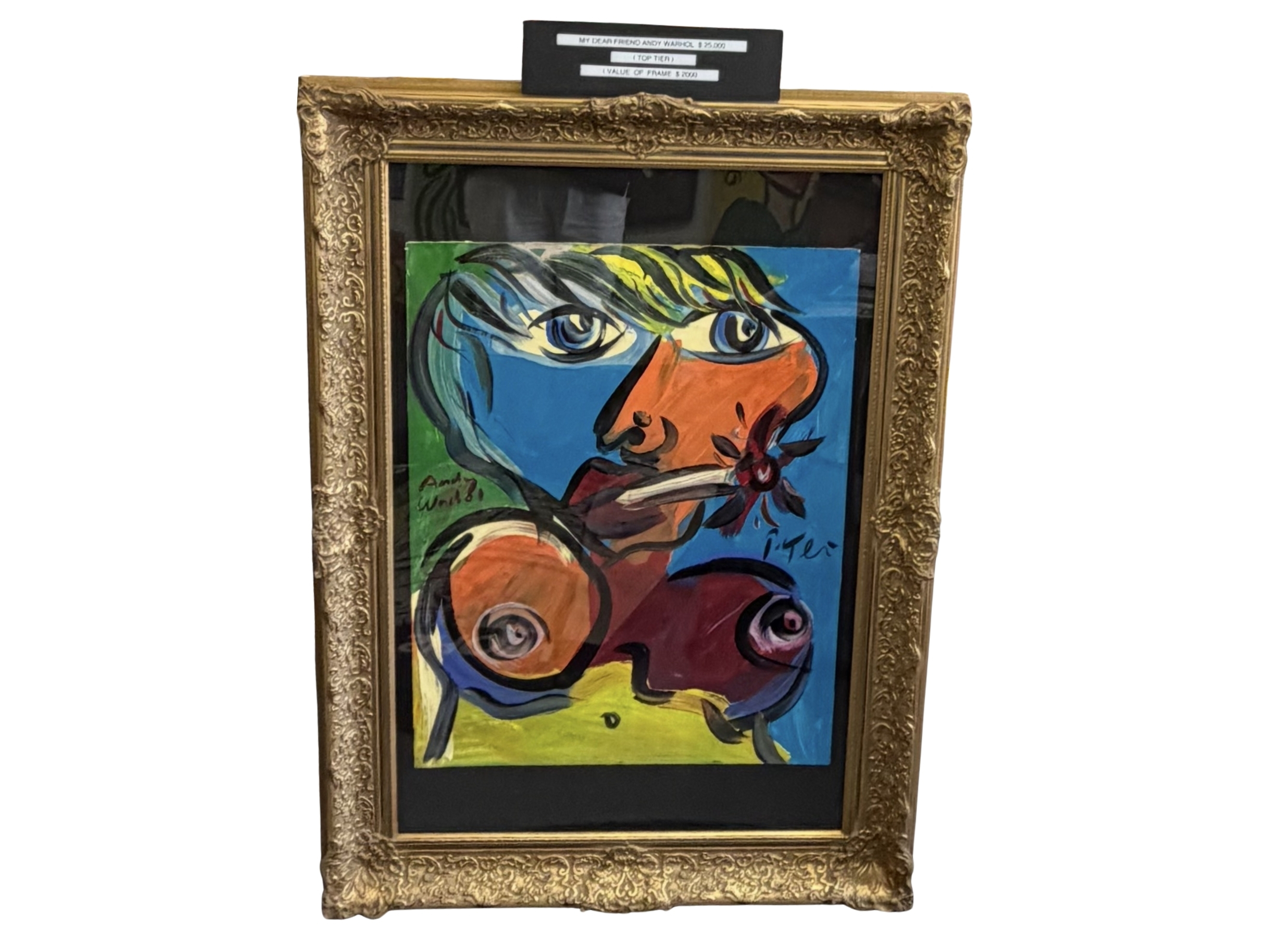
This is the most formally presented work in the group: a carved gold frame, the kind that belongs in a museum’s old-master rooms, surrounding a face that refuses to sit still. A cooler blue field distinguishes Andy Warhol My Dear Friend. Eyes sit high in the image, above an angular orange passage, while rounded forms gather across the lower portion. Black lines connect these elements without resolving them into a conventional, evenly proportioned head. The eye moves between features, following a composition that feels assembled through overlapping shapes. Pale accents and areas of yellow keep the darker colors from becoming visually heavy. Around the image, a dark inner border and ornate gold-toned frame provide a measured contrast to its irregular geometry. Of the three Warhol-titled pictures, this one most strongly invites the viewer to move back and forth between recognizing a face and reading an arrangement of abstract forms.
- Color: Blue and orange split the face, while yellow, green, and burgundy animate the forms around it.
- The gaze: Large, watchful eyes sit beneath a tangle of light and dark strokes, giving the head an alert, restless presence.
- Composition: Below the head, rounded shapes set up a rhythm of circles and curves, loosening the boundary between figure and setting.
- The frame: Old-world ornament meets a direct, modern image — a deliberate counterpoint.
Interpretation: The title places the work in a long tradition of artists portraying artists. Keil’s Warhol is not a documentary likeness; recognizable anatomy gives way to emotional intensity, and the face feels both immediate and reinvented.
Andy Warhol My Friend: Pop, Retold in Expressionist Color
Painting in a pink frame · Listed at $4,635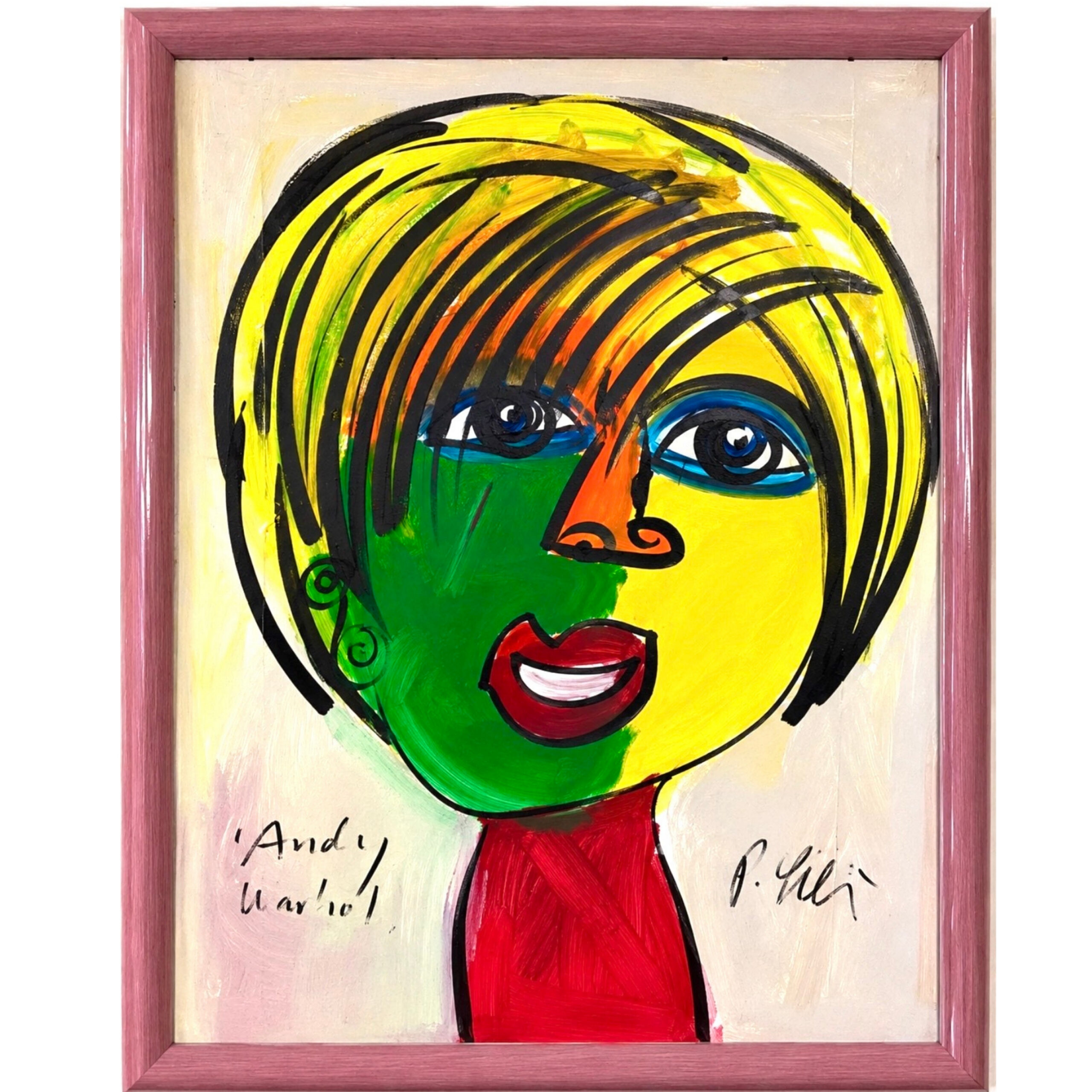
The brightest and most animated of the Warhol portraits, this one greets you with a shock of yellow hair, wide blue eyes, and an open red mouth. A rounded sweep of yellow hair gives this portrait an immediately legible silhouette. Black curved strokes travel across it, while green and yellow divide the face around an orange nose. Blue accents intensify the eyes, and the red mouth finds a visual echo in the long red neck below. The pale surrounding field gives the head space, making its circular shape and contrasting colors especially clear. A pink-toned frame adds another gentle boundary around the image. Compared with the fragmented structure of Andy Warhol My Dear Friend, this composition feels more centralized and open. Its individuality comes from the balance between an orderly outline and color relationships that remain deliberately unexpected.
- The hair: Long, curved yellow strokes turn the hairstyle into a rhythmic pattern that frames the gaze — perhaps a nod to Warhol’s famously pale hair.
- The split face: Vivid green and yellow divide the face, with an orange nose and bold black lines holding the features in place.
- Space: A narrow red neck anchors the oversized head against a pale ground, so the saturated color commands the canvas.
- The inscription: Warhol’s name is written by hand in the lower left, opposite Keil’s signature — the sitter named like a dedication.
Interpretation: The eyes suggest alertness, and the parted lips leave the impression of a thought about to become speech. It is both playful and psychologically engaging — proof of how much a few decisive lines can say.
Warhol My Friend: Face to Face, Up Close
Painting in a gold frame · Listed at $3,605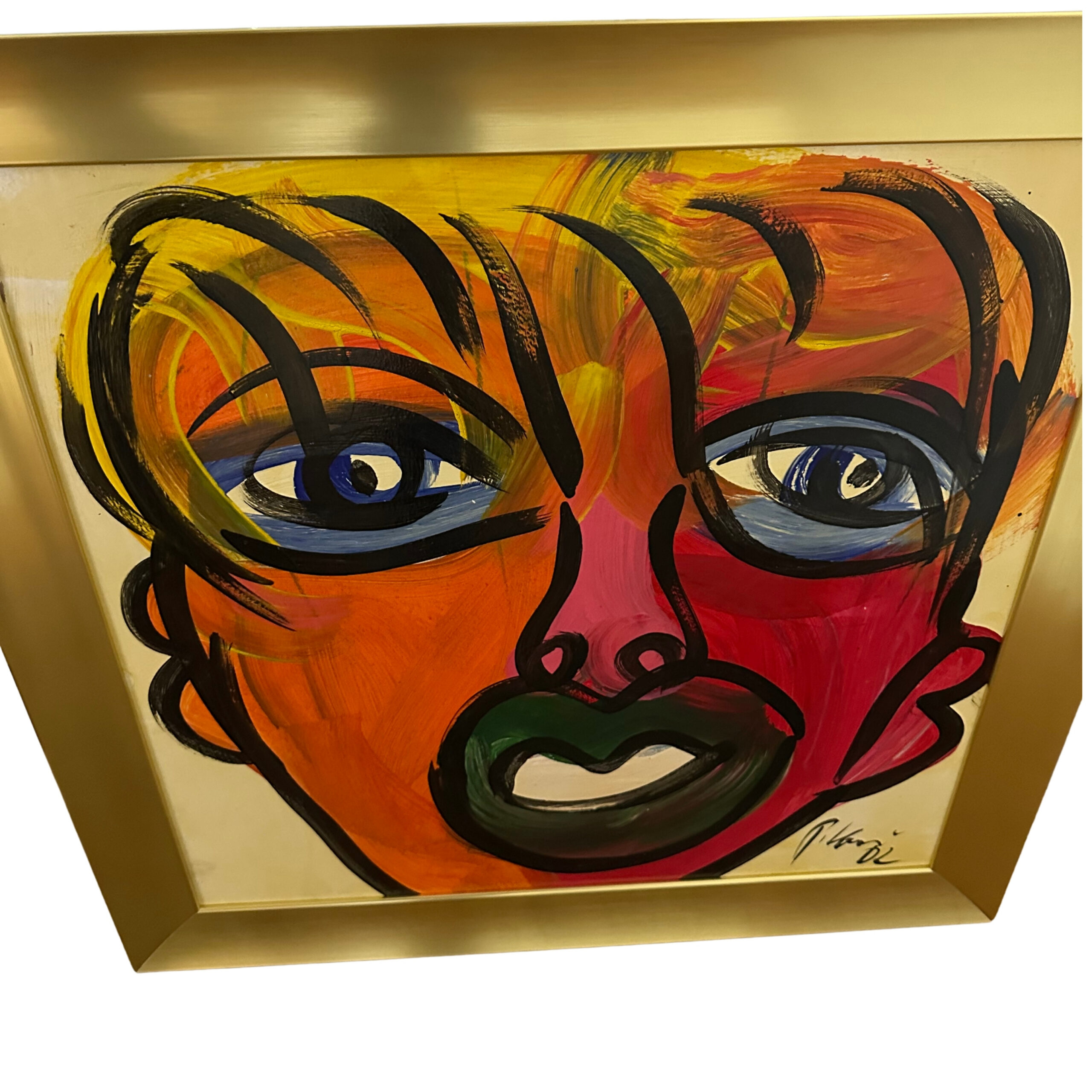
Where the other Warhol portraits leave room around the head, this one moves in close. The face nearly fills its gold frame, and the space feels compressed and charged. In Warhol My Friend, the face presses close to the picture’s edges. Broad orange and red passages divide the cheeks, while yellow and dark sweeping strokes animate the hair. Large eyes hold the upper half of the composition; a green-black outline around the mouth gives the lower half an equally forceful anchor. The visible strokes follow different directions, creating movement across the forehead and around the features. The gold-toned frame sets a firm perimeter around that activity. This is the most tightly cropped of the three Warhol-titled works here, creating a sense of proximity: the viewer encounters the expression before having much surrounding space in which to settle.
- Palette: Broad areas of orange and red create an impression of heat and immediacy.
- Line: Yellow and dark strokes sweep across the forehead like unruly locks of hair.
- The eyes: Large and blue, outlined in heavy black curves, they hold an insistent, direct gaze.
- Balance: A dark mouth with a pale interior anchors the lower half against the activity around the eyes.
Interpretation: Keil leaves his brushwork visible, so the painting of the face becomes part of its force. The fixed gaze against restless lines makes the portrait feel at once confrontational, curious, and open.
Picasso My Mentor And Friend (Set of 2): A Conversation in Red
Pair of paintings in black frames · Listed at $4,635 for the set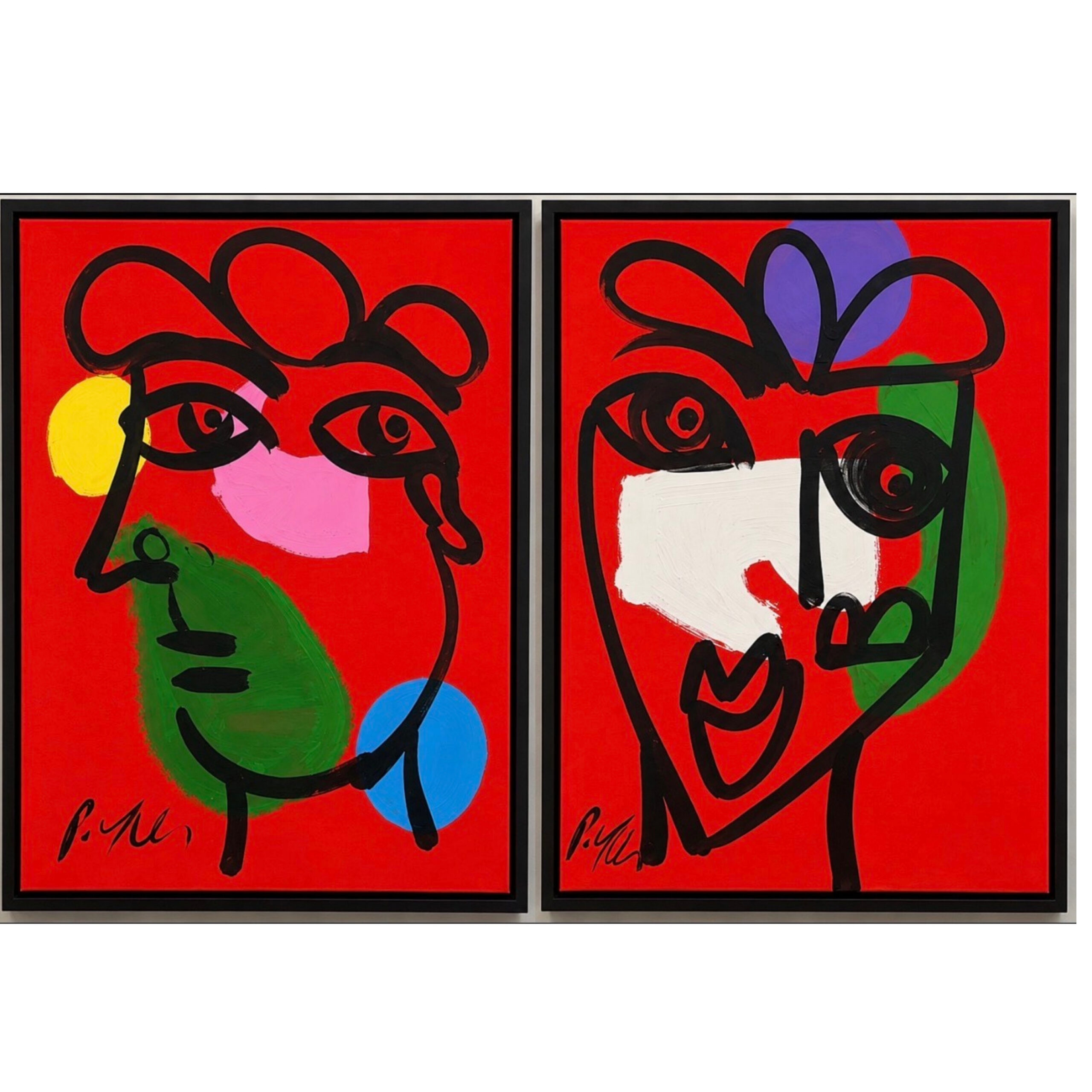
This pair carries the most personal title in the collection — and a real history behind it. Keil copied Picasso’s style as a young artist and later met him in Spain. A brilliant red ground connects these two framed works, while looping black lines give each face its own architecture. In the left composition, green spreads through the lower face, a pink passage sits beneath the eyes, and blue adds weight near the bottom. In the right, white opens a larger area at the center, balanced by green at the side and purple above. The repeated format encourages comparison. Related curves and almond-shaped eyes establish kinship, yet the changing distribution of color prevents the pair from becoming a simple repetition. The space between the two frames becomes a pause between variations. Read together, the works suggest a conversation about how many different expressions can emerge from a small vocabulary of lines and shapes.
- The pairing: Two portraits on vivid red grounds, each in a black frame, made to be read side by side.
- Line: Thick black lines loop and sweep into hair, eyes, noses, and mouths.
- Accents: Green, pink, white, blue, and purple interrupt the red, giving each face its own balance of shapes.
- Two viewpoints: One face leans toward profile; the other combines frontal and sideways features at once — an approach that echoes Picasso’s own reinvention of the face.
Interpretation: This is homage without imitation. The dialogue between the two panels mirrors the one between student and master, with room left for humor, ambiguity, and recognition.
Part II · Painted Objects
Original Longboard: A Crowd Moving Along the Deck
Painted longboard · Listed at $1,236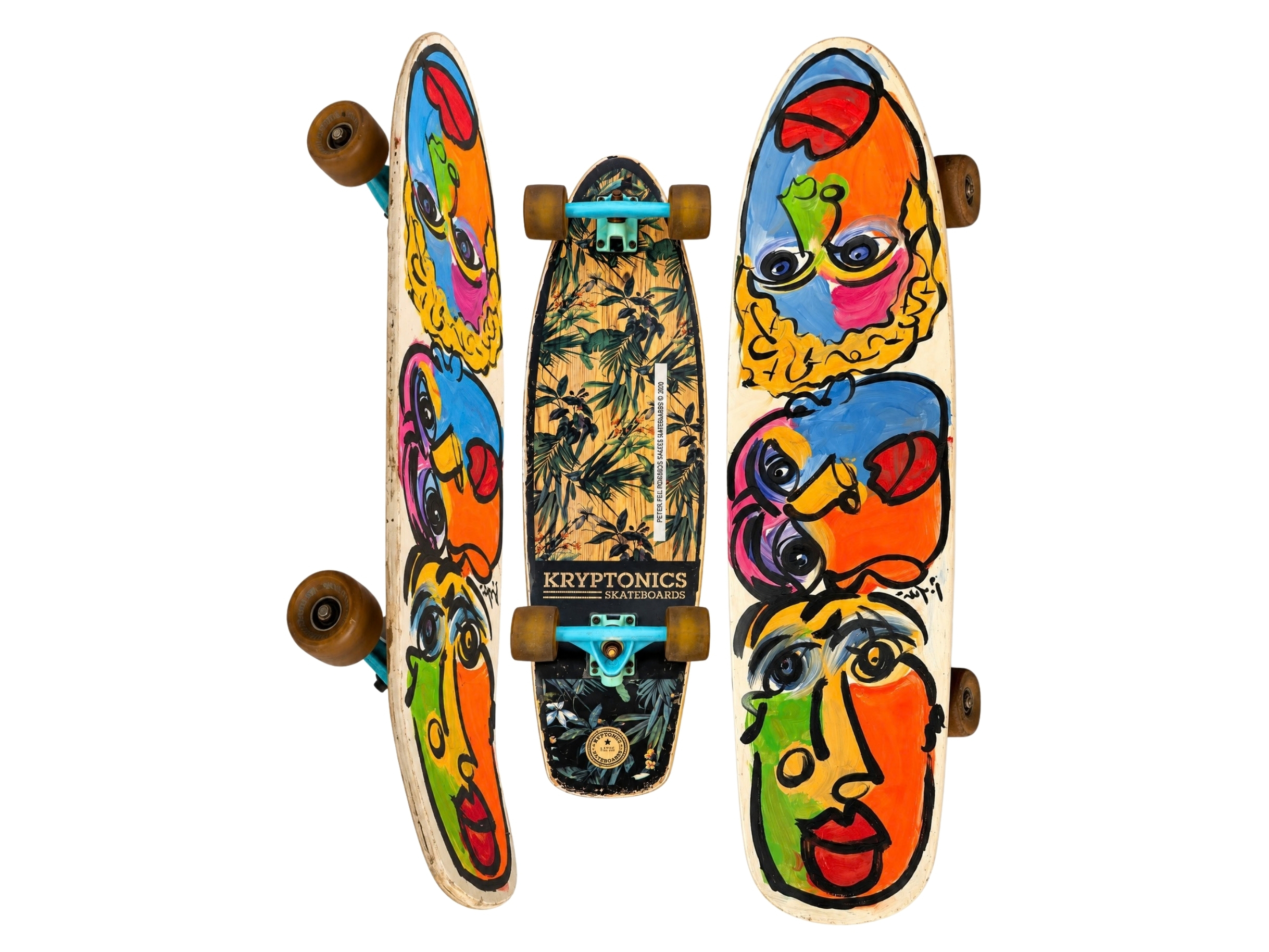
Keil turns an elongated longboard deck into a procession of faces, stacked nose to chin from one end to the other. The longboard’s elongated deck turns portraiture into a sequence. Faces travel along its length, changing orientation as blue, orange, yellow, and green meet within strong black boundaries. The narrow surface brings the heads close together, making their adjacency part of the work’s rhythm. Its tapered ends also matter. Curves in the faces answer the changing outline of the board, while the visible wheels and hardware preserve its identity as an object associated with movement. That association offers an engaging way to read the painted procession: even at rest, the work directs the eye from one end to the other.
- Composition: The portraits follow the board’s narrow shape, and their varied orientations pull the eye along its length.
- Color: Black outlines organize patches of orange, blue, green, yellow, and pink, with large eyes and red lips as points of focus.
- The object: Wheels and trucks remain in place, and the underside keeps its original tropical palm-print graphic — a reminder that this board was built to ride.
Interpretation: Curving hair, tilted features, and overlapping color give each face its own personality. Together they read like a crowd waiting to roll — expressive portraiture meeting skate culture on equal terms.
Original Skateboard: A Portrait Gallery on Four Wheels
Painted skateboard · Listed at $1,236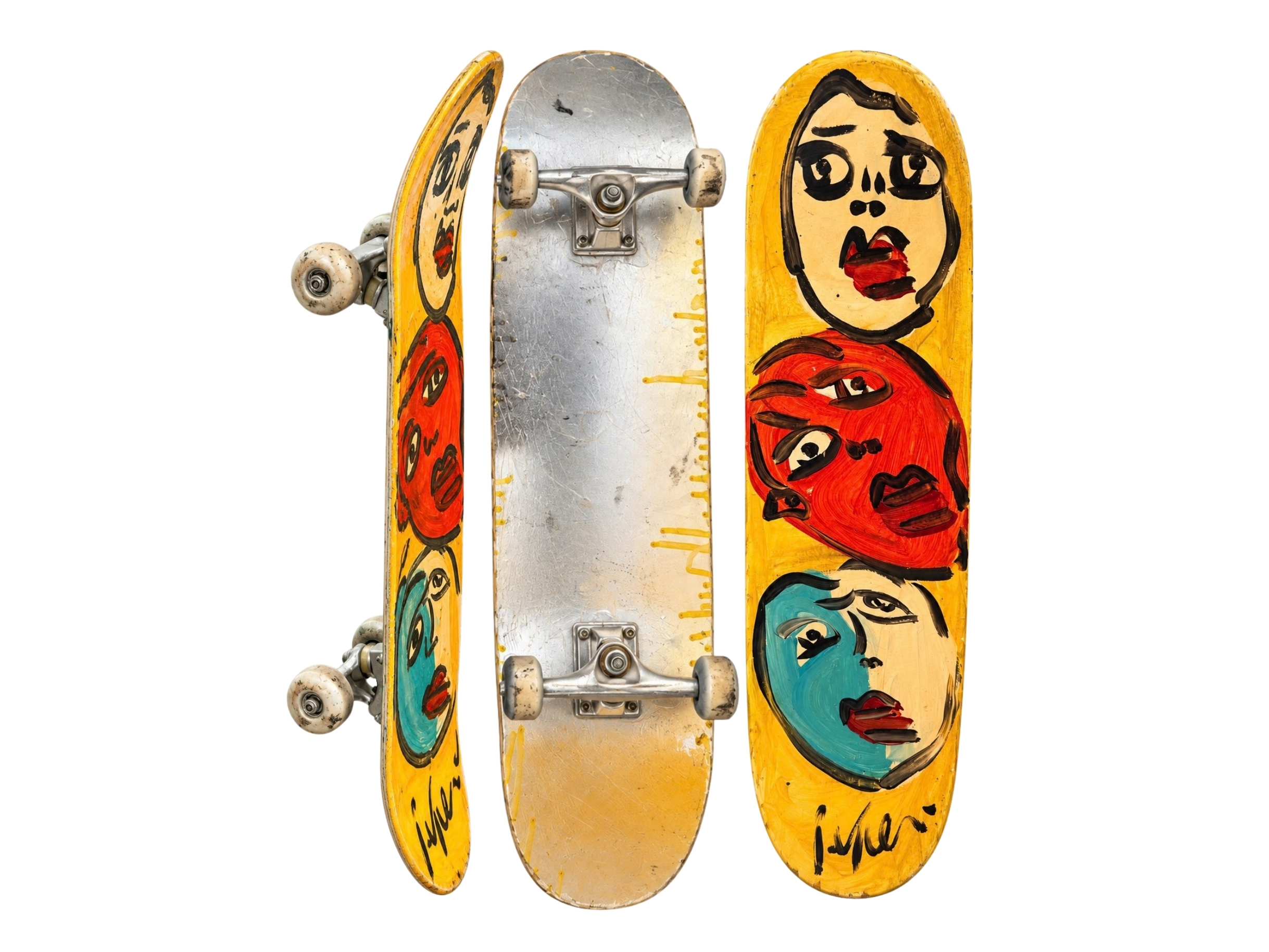
Three faces share a warm yellow deck, turning a familiar object of movement into a compact, three-part portrait gallery. Three faces occupy the skateboard’s bright yellow deck. A pale face at the top, a red face through the middle, and a smaller blue-green passage below create distinct intervals along the surface. Black outlines and red lips provide continuity across those changes. Unlike the longboard’s closely interlocking color areas, this work allows more of the yellow ground to remain visible around the heads. The rounded deck becomes a compact stage for a vertical arrangement of expressions. The object’s familiar proportions are essential to the effect: the painting has been organized around a surface with its own recognizable shape and physical presence.
- Sequence: A pale face occupies the top, a red face commands the center, and a turquoise face completes the run below.
- Shape: The rounded ends of the deck echo the contours of the heads, so the board itself becomes part of the composition.
- Line: Strong black strokes define wide eyes, curved noses, and open red mouths.
- The object: Metal trucks and wheels remain on the reverse, keeping the board recognizably itself.
Interpretation: Differing colors and expressions set up a conversation across the deck. Keil’s loose, direct handling makes it feel as though each expression has just arrived.
Original White Chair: A Seat That Looks Back
Painted wooden chair · Listed at $5,665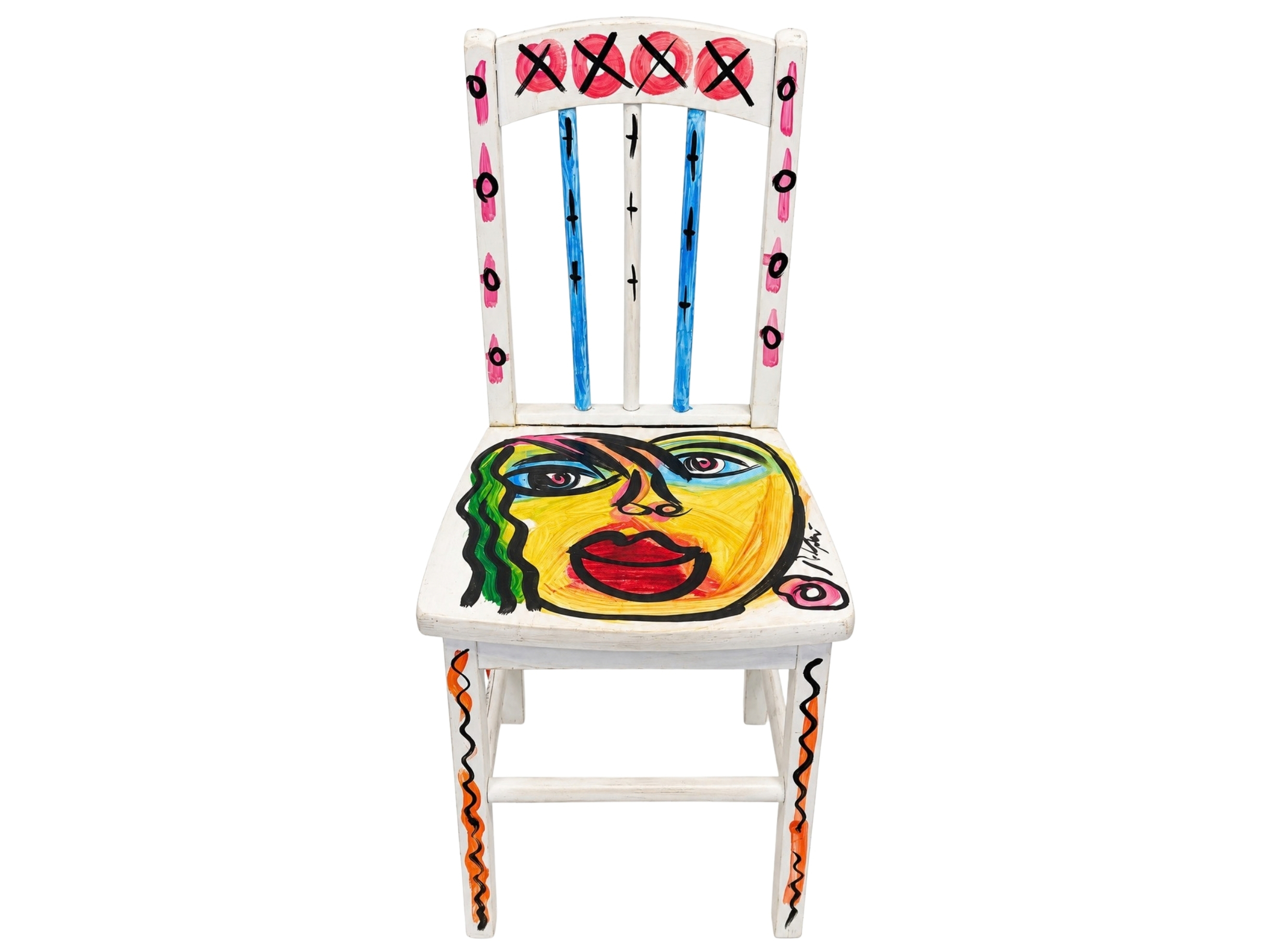
Here the portrait leaves the wall entirely. A face spreads across the seat of a white chair, and the rest of the frame becomes its costume. The chair distributes Keil’s imagery across several connected surfaces. A large face fills the seat, its red mouth and outlined eyes surrounded by yellow, green, and blue. Above it, blue vertical accents emphasize the back’s slats, while black circles and crossed marks punctuate pink areas along the upper rail and side posts. White remains visible throughout, separating the painted details and clarifying the chair’s structure. Smaller marks continue down the legs, encouraging attention to move beyond the central face. The object becomes a composition in three dimensions, with the seat acting as its focal point and the back and legs extending its rhythm into the surrounding space.
- The seat: Yellow and green areas sit inside black contours; wide eyes look upward, and full red lips hold the center.
- The structure: Pink circles crossed with black marks line the top rail, blue accents run down the back, and orange details enliven the legs.
- White space: The chair’s white paint separates each gesture, so every color registers cleanly.
- In the round: The imagery follows the chair’s changing surfaces, inviting you to look from above, from the front, and all the way around.
Interpretation: Keil gives ordinary furniture a theatrical personality. The chair becomes both a support for the body and a face looking back — whether you choose to sit on it is entirely up to you.
Vivid Pink Luggage: Faces in Transit
Painted suitcase · Listed at $3,090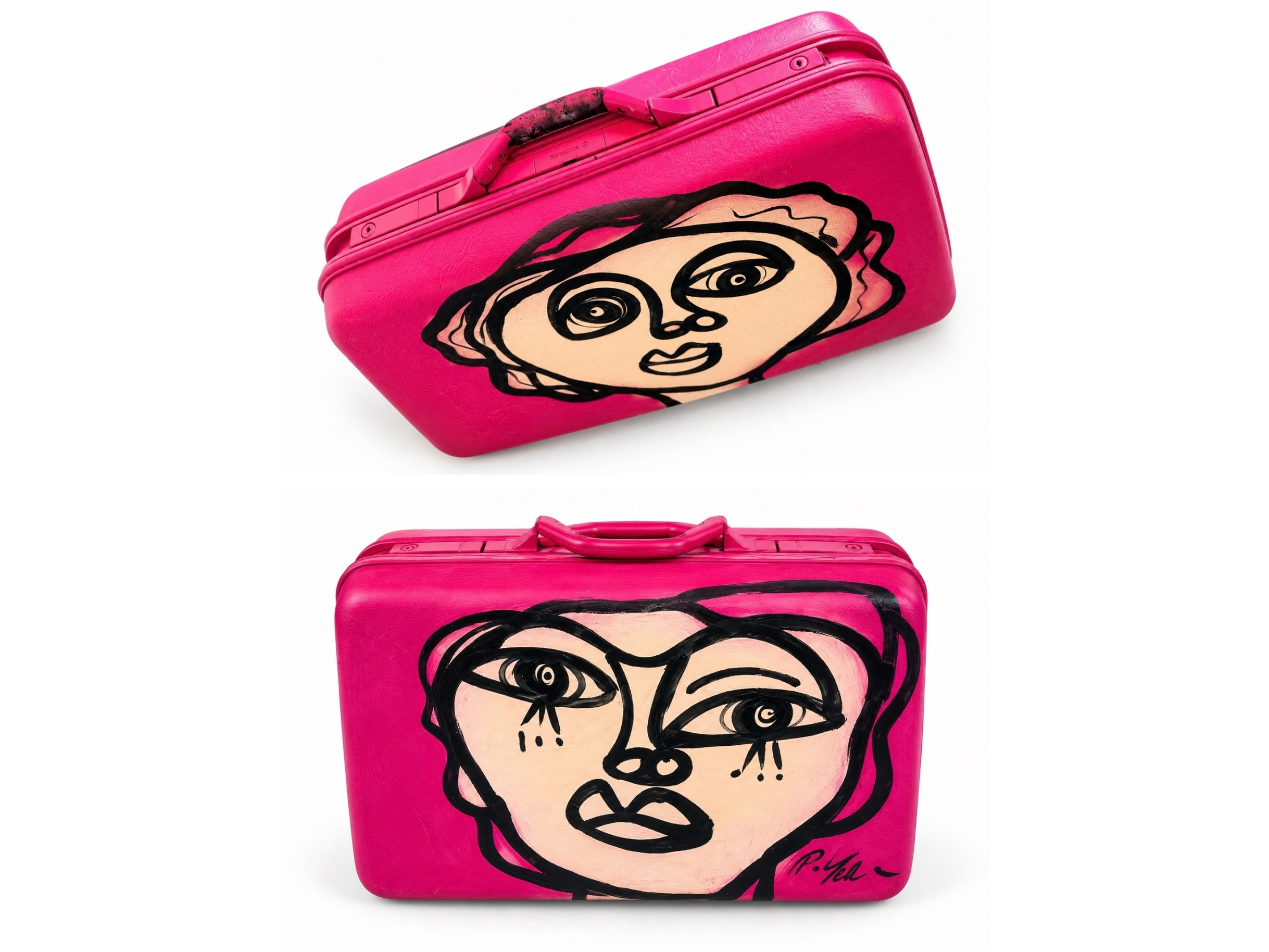
A hot-pink case becomes a portable stage. Pale faces emerge from the saturated surface, each one drawn in bold black strokes. The luggage’s saturated pink surface serves as both an object’s exterior and a pictorial ground. Pale faces stand out against it, their eyes and mouths defined through generous black curves. The photographed views reveal different expressions: rounded eyes and a small smile in one, more asymmetrical features and descending marks beneath the eyes in another. The handle, seams, and rounded corners remain part of the encounter. They locate the imagery on something designed to be carried, giving the face an association with journeys and personal belongings. That reading is an invitation rather than a fixed narrative; the immediate visual achievement is how confidently the large facial shapes inhabit the compact pink surface.
- Contrast: The pink supplies a strong field of color; the faces bring curiosity, surprise, and composure through oversized eyes, curved brows, and outlined mouths.
- The object: Handles, seams, and rounded corners remain visible, keeping the case’s everyday identity part of the experience.
- In the round: Different surfaces carry different faces, so moving around the case means meeting a new expression.
Interpretation: The work joins the associations of travel with the intimacy of a face — encounters, departures, and the personalities we carry with us. It is a suitcase with a story still unfolding.
Connections Across the Works
The recurring face provides continuity, but each support establishes a different pace. The Picasso pair asks the eye to compare two adjacent images. The framed Warhol works vary the distance between viewer and subject through cropping, open space, and fragmentation. The boards arrange faces along a narrow axis, while the chair and luggage bring expression into objects with volume and familiar uses. Across the selection, the shape of the object helps determine the shape of the painting. Color also performs different tasks. Red unifies the paired portraits; pale surroundings give one Warhol head breathing room; white separates the chair’s decorative passages; and pink becomes an enveloping field on the luggage. These choices give each work a distinct structure within Keil’s recognizable vocabulary of bold contours, enlarged features, and expressive color. Seen together, the eight pieces read like one long conversation carried on across very different surfaces.
- One vocabulary, many surfaces. The same black contour, split-color face, and outsized eye appear on canvas, wood, a skate deck, and a suitcase shell. Keil adapts the object; he never changes his hand.
- Two giants, one voice. Warhol was the master of cool, mechanical Pop; Picasso reinvented the face itself. Keil paints both in his own hot, hand-drawn language rather than borrowing theirs.
- Frames as characters. Ornate gold, candy pink, and gallery black each set a different tone for the portraits. The objects need no frame at all — their shape does the framing.
- Near and far. Warhol My Friend presses the face right up to the edges, while Andy Warhol My Friend gives the head room to breathe. The crowded Original Longboard and the orderly three-face Original Skateboard play out the same contrast in wood.
- Art you live with. Four works hang on the wall; four ask to be sat on, ridden, or carried. Together they bring portraiture into the rhythms of daily life.
Whether it hangs on a wall or rolls down the street, a Keil is always looking back at you.
See Peter Robert Keil in Person
Photographs capture the color, but the objects especially reward a visit — you need to walk around the chair, the boards, and the suitcase to meet every face. The full collection is on view at The HUB Bridgehampton Art Gallery, where paintings and painted objects offer several ways to encounter Keil’s work. Follow the individual links for listing details, explore the complete collection, or contact the gallery with questions about a particular piece.
Location: The HUB, 2183 Montauk Highway, Bridgehampton, NY 11932
Hours: 10:00 a.m. – 6:00 p.m., closed Tuesdays
Admission: Complimentary
Inquire About Peter Robert Keil Artwork →
Explore the Full Collection →
The collection at a glance
- Andy Warhol My Dear Friend $7,725
- Andy Warhol My Friend $4,635
- Warhol My Friend $3,605
- Picasso My Mentor And Friend (Set of 2) $4,635
- Original Longboard $1,236
- Original Skateboard $1,236
- Original White Chair $5,665
- Vivid Pink Luggage $3,090