
The HUB × Art Hampton · Bridgehampton
Made of the Real Thing: Greg Weinstein’s Pop Culture Icons
Comic Book Superheroes, the Beatles photographs, and Grateful Dead built from their own sheet music — five collages in which every color is a piece of paper, cut by hand rewarding recognition from a distance & discovery up close at The HUB.
Visit The HUB · At 10AM-6PM — Wednesday To Sunday · 2183 Montauk Highway, Bridgehampton, NY 11932
Greg Weinstein doesn’t paint pop culture. He cuts it out of itself. His comic-book heroes are made from original comic-book pages. His Beatles are made from Beatles photography. His Grateful Dead tributes are made from Grateful Dead photography and sheet music. Nothing is printed, scanned, or reproduced — every color is a fragment of the real thing, trimmed by hand and glued down one piece at a time. The five works at The HUB form a small, joyful survey of American and British pop memory: two American flags — Spider Spangled Banner and Betty & Veronica Chronicles — a psychedelic London panorama in Fab Four Ever, and a pair of Grateful Dead pieces, Cherry Garcia: A Pint of View and Friend of the Crowd. Each one works at two distances. From across the room, you see a bold, instantly readable icon: a flag, a pint, a face. Step closer, and it dissolves into thousands of fragments — faces, speech bubbles, stage lights, musical notes. What sets his work apart is simple to state and painstaking to achieve: every fragment once belonged to the story it now tells.
The Artist’s Creative Approach
Greg Weinstein is a hand-cut collage artist based in Port Washington, New York. His practice began at the breakfast table. When his daughters were 8 and 11 and working their way through box after box of Honey Nut Cheerios, he found himself drawn to the packaging — its amber color and glossy print. He kept a few boxes and made his first piece from them on a rainy Saturday afternoon. Encouraged, he set himself a much larger challenge: a portrait of Muhammad Ali made from 100 vintage Wheaties boxes. It took about nine months, much of it late at night. From there his materials grew to comic books, sheet music, candy wrappers — iconic imagery and bold color that spoke to the 1970s latchkey kid in him. His one rule is authenticity. In his words, “Everything I use is the real thing” — comics from the dollar bin, boxes found on eBay, worn coffee-table books from yard sales. Their flaws and signs of use are part of the character. He finishes about ten works a year, and some take months. With each one, he says, he is capturing a piece of his childhood — and, along the way, a piece of his daughters’ too.
From idea to finished collage: his seven-step process
- Imagine — choose a subject worth months of work.
- Source — hunt down vintage printed material; never buy new.
- Design — plan the composition in pencil sketches.
- Cut — every shape by hand; a single flag can take two to three thousand cuts.
- Sort — organize fragments by color, character, and size.
- Paste — adhere each fragment, one at a time.
- Seal — finish with a protective coating.
A Closer Look at the Featured Works
The collection divides into two families: flags stitched together from comic books, and tributes to music built from the bands’ own imagery.
Part I · Flags of Fiction
Spider Spangled Banner: One Flag, Two Heroes
Approx. 3,000 hand-cut pieces of original comic-book pages on wood panel · 36″ × 48″ · Listed at $8,240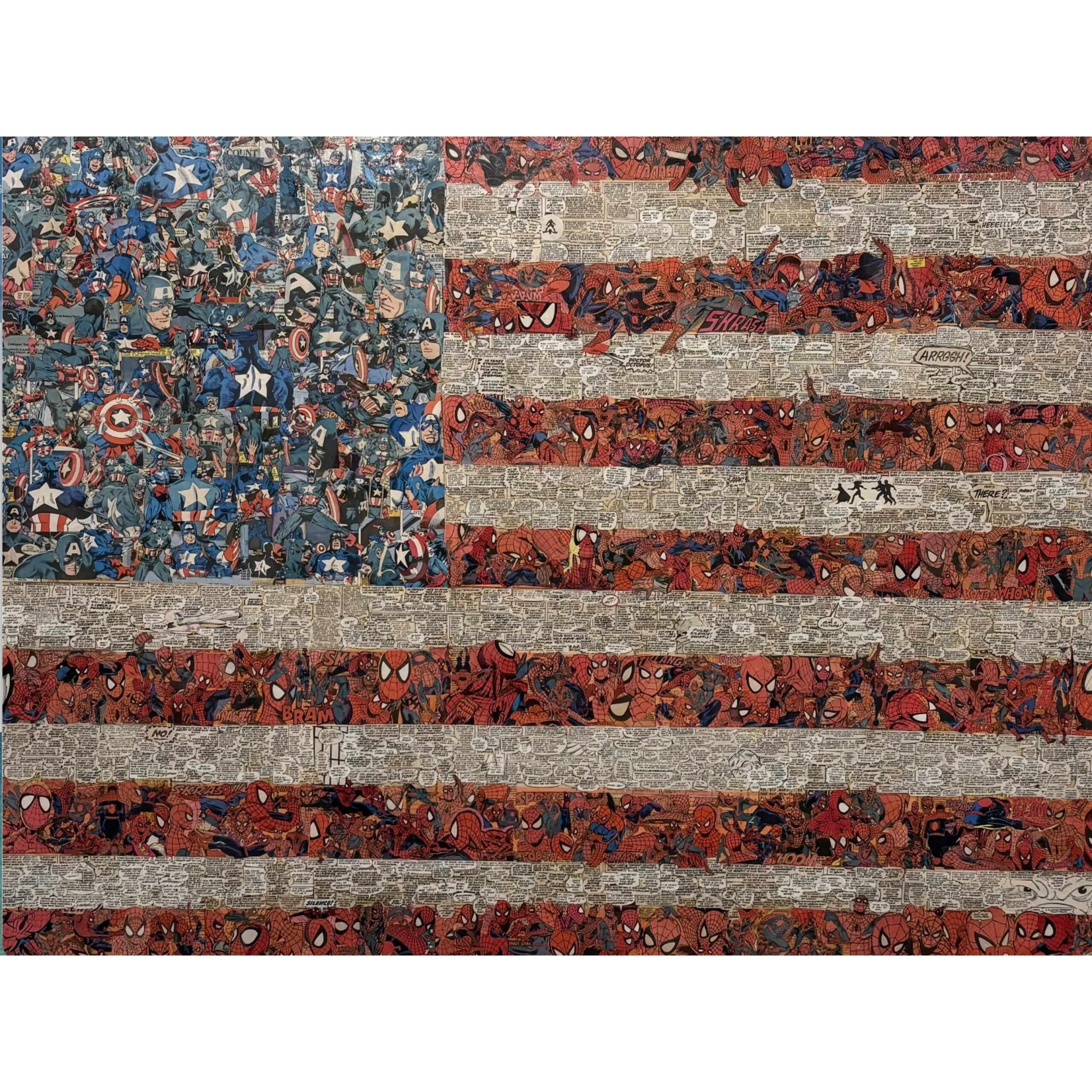
The flag is instantly recognizable. What it is made of takes longer to see: roughly three thousand fragments of Captain America and Spider-Man comics, each one cut and placed by hand. Spider Spangled Banner brings Captain America and Spider-Man into a single national emblem. Spider-Man’s red costume supplies much of the energy in the horizontal bands, while blue imagery gathers in the upper-left field. Pale strips of dialogue and line drawing separate the stronger colors, maintaining the flag’s overall structure. The approximately 3,000 pieces make the achievement one of selection as well as cutting. Each fragment contributes color, shape, and narrative at the same time. A figure must work as part of a stripe while remaining a recognizable comic image. The resulting surface moves between orderly geometry and the changing poses, expressions, and action of its source pages. The artist’s accompanying statement focuses on the two heroes’ beginnings as ordinary people who become extraordinary. That reading gives the familiar flag an aspirational dimension. The work asks viewers to consider possibility and responsibility through characters whose stories are physically present in the emblem itself.
- Color from character: The heroes’ own costumes supply the palette. Captain America’s blues and shields gather in the canton, while Spider-Man’s red suit fills the red stripes.
- Structure: Pale bands of illustrated panels alternate with the red, so the flag’s rigid geometry holds a surface alive with poses, faces, and action.
- Two readings: From afar it is a national emblem; up close it becomes an unfolding world of narrative fragments.
- Scale: At 36 by 48 inches, the panel is large enough for the stripes to read clearly and dense enough to reward long looking.
The artist’s intent: Weinstein notes that neither hero started out as anyone special. Both were ordinary, and both became extraordinary — which, for him, is what America is about: everyone has the power to rise to greatness.
Betty & Veronica Chronicles: Forty Hearts and a Friendship
Hand-cut collage of original comic-book pages on canvas · 36″ × 48″ · Listed at $8,240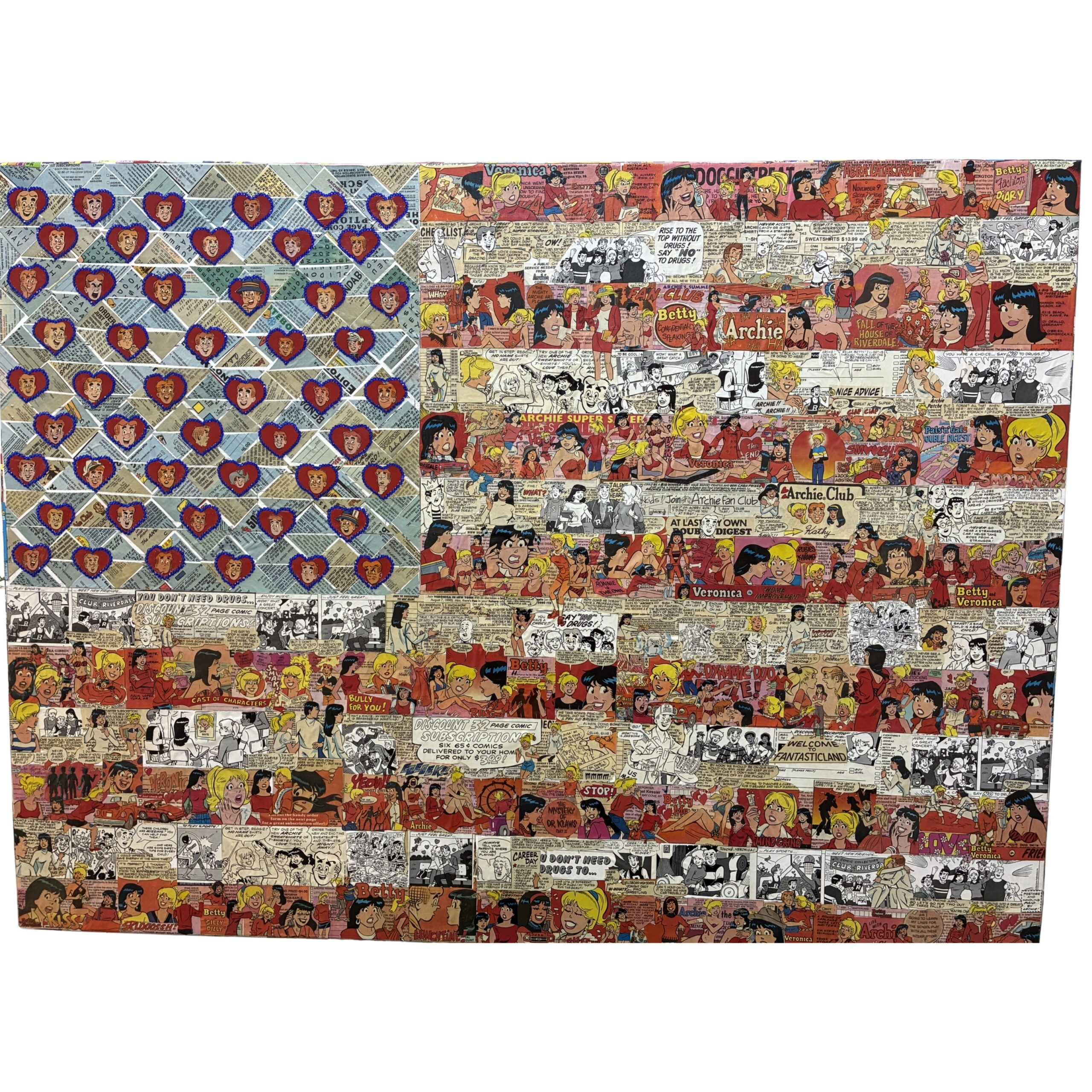
The second flag trades stars for hearts. Forty hearts fill the canton, set against a blue-and-white lattice, and the stripes are built from the long-running comic adventures of Betty and Veronica. In Betty & Veronica Chronicles, the American flag’s familiar arrangement becomes a framework for comic-book storytelling. Bands of colorful illustration alternate with pale passages of text and line drawing. In the upper-left field, forty hearts take the place of stars, shifting the emphasis toward relationships and affection. The work operates through repetition at several scales. Stripes organize the whole; comic panels divide the surface into smaller scenes; recurring faces and speech bubbles create another rhythm within them. The warmer colors of the illustrated bands distinguish them from the quieter, text-heavy sections, allowing the flag to remain clear despite the density of its contents. Weinstein’s artist notes give the hearts a specific emotional context. Betty and Veronica’s rivalry persists across stories and decades, yet their friendship endures. The work treats that coexistence of jealousy and loyalty as a form of devotion. Seen through that lens, the flag becomes a setting for the small, complicated bonds that hold people together.
- Stripes as story: Rows of comic panels form alternating bands — warm reds and yellows in one, pale black-and-white newsprint in the next.
- Everyday drama: Where Spider Spangled Banner is all action, this flag is full of familiar faces, speech bubbles, and small moments of teenage life.
- Tension: The orderly stripes contrast with the restless comic scenes, giving the surface a playful, busy energy.
- Support: Unlike its wood-panel companion, this collage is mounted on canvas.
The artist’s intent: Weinstein sees in Betty and Veronica a rivalry that never broke anything. They compete for the same boy issue after issue, decade after decade, and the friendship holds. Jealousy and loyalty run through the same story — a devotion he calls its own quiet form of love.
Part II · Songs in Paper
Fab Four Ever: From Black and White to Full Color
Hand-cut collage of Beatles photography on wood panel · Listed at $8,240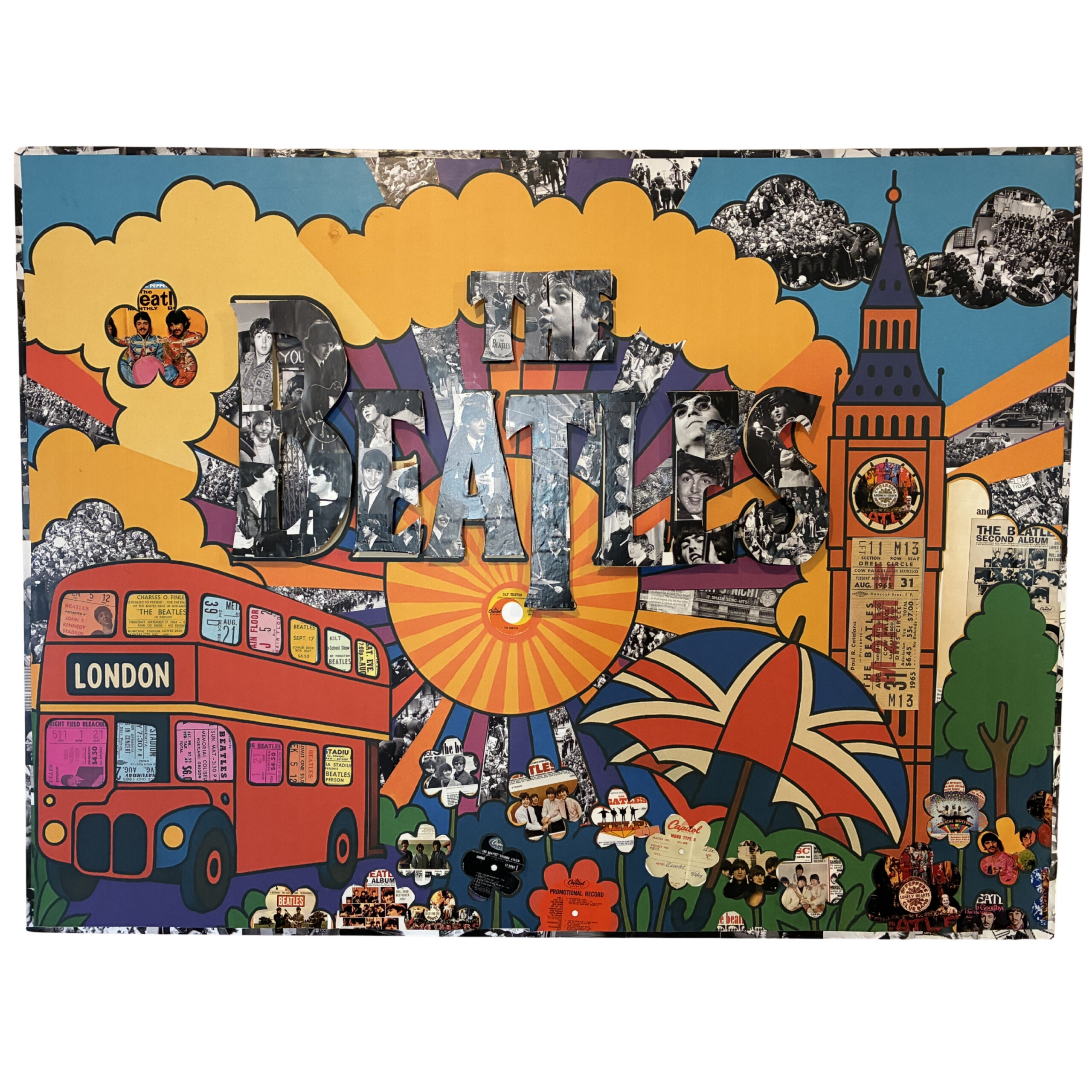
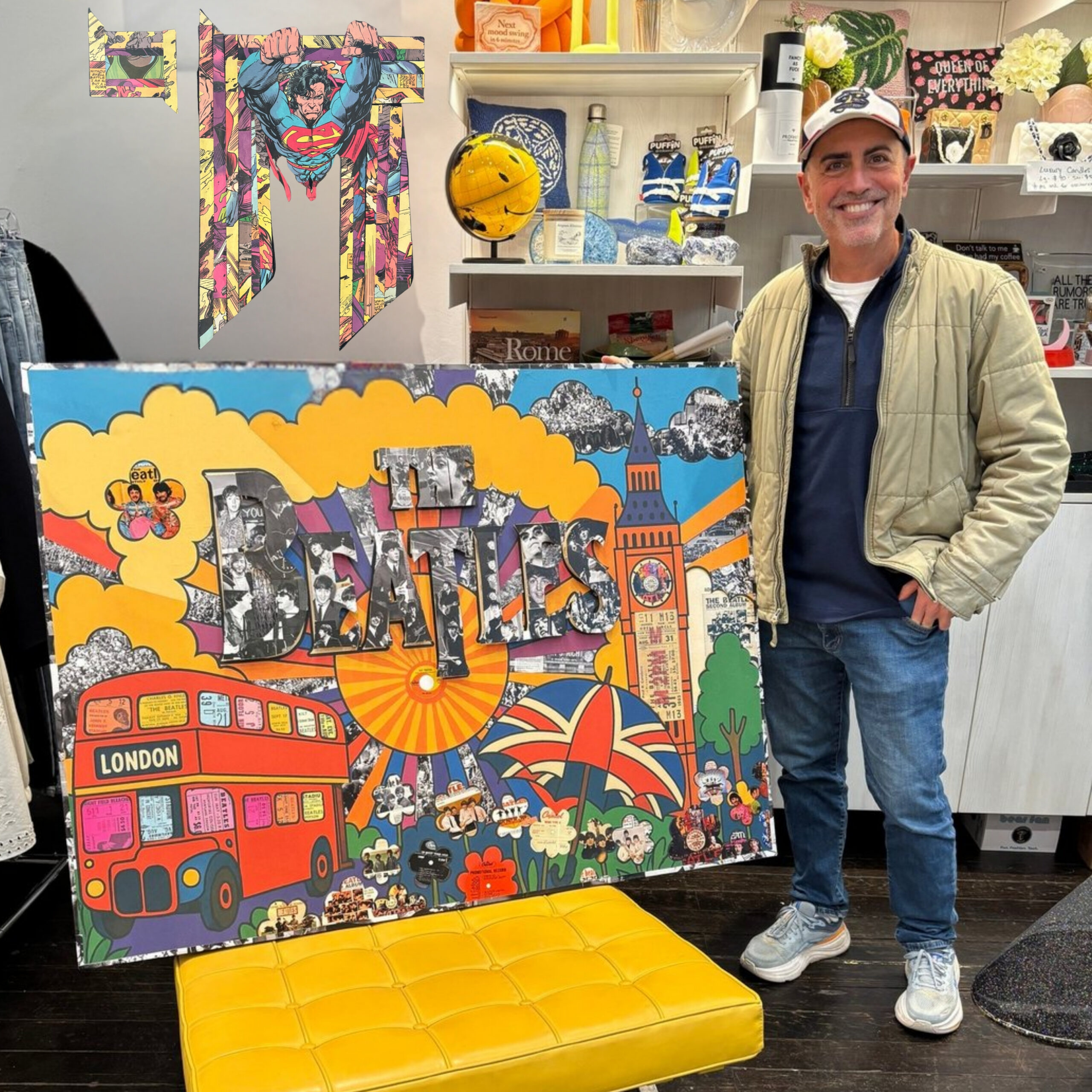
A buoyant, psychedelic panorama of London, built around oversized lettering that spells out the band’s name. Large Beatles lettering anchors Fab Four Ever, its photographic interiors set against a bright field of yellow, blue, and orange. A red double-decker bus occupies the lower left, while Big Ben rises at the right. The Union Jack and radiating bands of color carry the eye across the lower portion, giving the composition a sense of outward expansion. The arrangement balances broad graphic shapes with small photographic details. The lettering remains readable even as its interior breaks into separate images. Weinstein’s website identifies another carefully chosen detail: the bus windows are concert ticket stubs. That decision connects a recognizable London symbol with the material record of attending a performance. The artist’s accompanying note links the Beatles’ early black-and-white image with the color they brought into the world. The collage gives that thought a visual structure through monochrome photographs surrounded by exuberant color. It reads as a celebration of a band & of the larger imaginative world that listeners attach to its music.
- The lettering: Large letters stretch across the composition, filled with black-and-white photographic fragments.
- The setting: A red double-decker bus, Big Ben, and the Union Jack anchor the scene in London, with flowers and small figures tucked throughout.
- Color and motion: Billowing yellow forms, blue sky, and radiating orange bands give the whole panel a sunburst energy.
- Density: The packed surface invites the eye to wander, discovering new connections among familiar symbols.
The artist’s intent: Weinstein describes the Beatles as having arrived in black and white — four kids from a bombed-out Liverpool who left the world brighter than they found it. The composition enacts that story. Black-and-white photographs sit inside the letters, while full color bursts out all around them.
Cherry Garcia: A Pint of View: A Flavor With a Backstory
Hand-cut collage of Grateful Dead photography and sheet music, framed · Listed at $2,575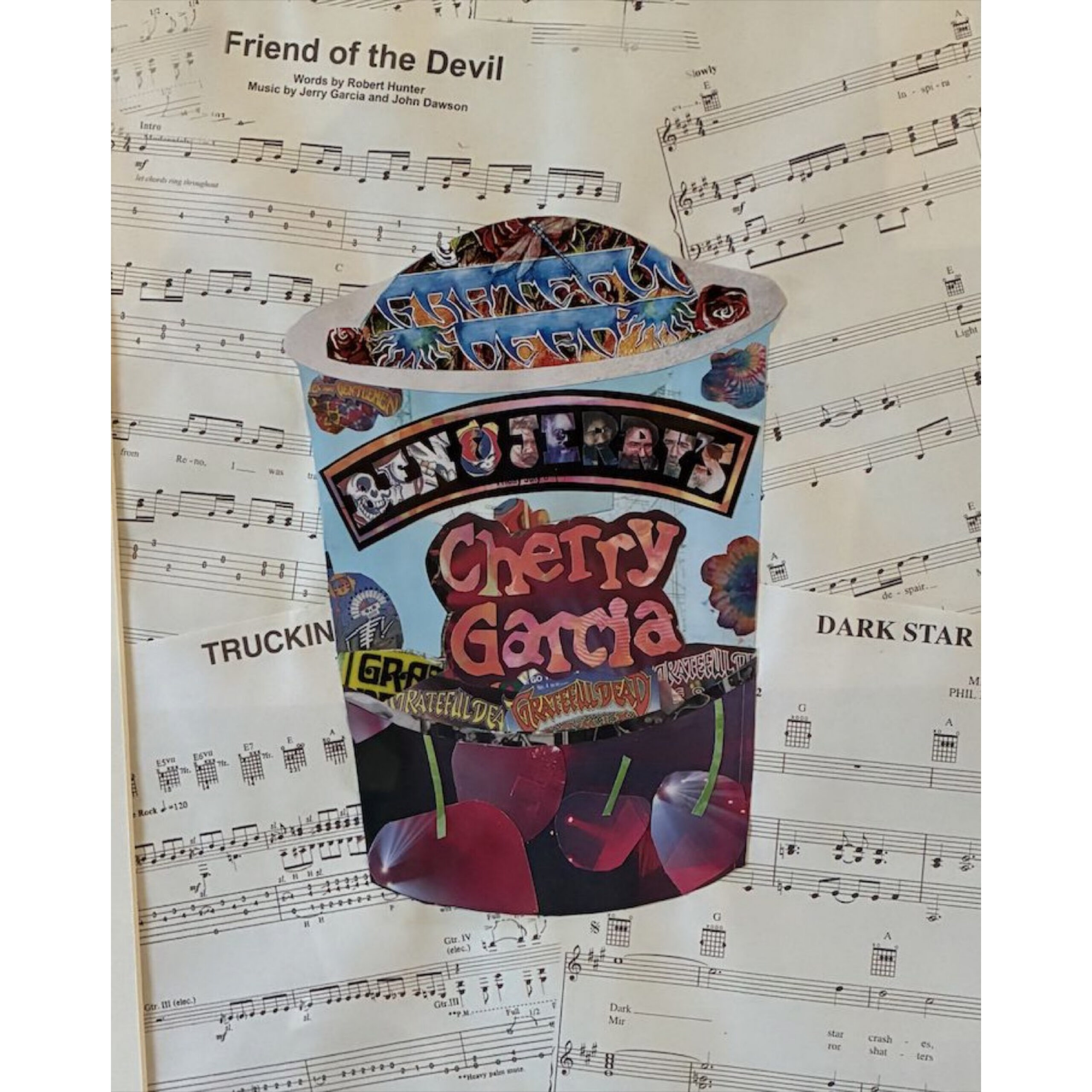
The title is a pun, and the picture is a pint: a Ben & Jerry’s Cherry Garcia carton rendered in Grateful Dead photography and set over overlapping pages of the band’s sheet music. A Ben & Jerry’s Cherry Garcia pint sits at the center of this composition, surrounded by overlapping sheet music. Its pale blue upper section, curved lettering, and deep cherry-colored base establish a recognizable package silhouette. The surrounding pages introduce a lighter field crossed by musical staves and notes. The pint image is constructed from Grateful Dead photography, making its connection to music part of its physical makeup. The density of imagery within the carton contrasts with the more open spacing of the score around it. Curved edges and oversized lettering draw attention inward, while the angled sheets carry that attention back across the background. The title’s wordplay suits the work’s affectionate humor. An everyday product becomes a meeting point for a musician’s identity, a recognizable brand, and the shared language of fandom. The sheet music provides a visual beat, giving the central package a setting that keeps its musical associations close at hand.
- The ground: Scores for Dead songs, including Friend of the Devil, Truckin’, and Dark Star, extend beyond the carton’s silhouette.
- Shape against line: The rounded pint and bold lettering play against the measured, horizontal lines of the musical staves.
- Color: Rich cherry reds, pale blue, and dark accents, with fragments of colorful imagery breaking up the carton’s familiar design.
The artist’s intent: Weinstein’s note recalls how, in 1986, a Deadhead in Portland, Maine, pinned a flavor suggestion to a shop bulletin board, and it became one of Ben & Jerry’s most iconic pints. The pairing worked, he writes, because the two were kindred spirits — community-built rather than marketing-made. The collage turns an everyday object into a vessel for fandom and memory.
Friend of the Crowd: A Portrait Made of Its Audience
Hand-cut collage of Grateful Dead photography and sheet music, framed · Listed at $2,575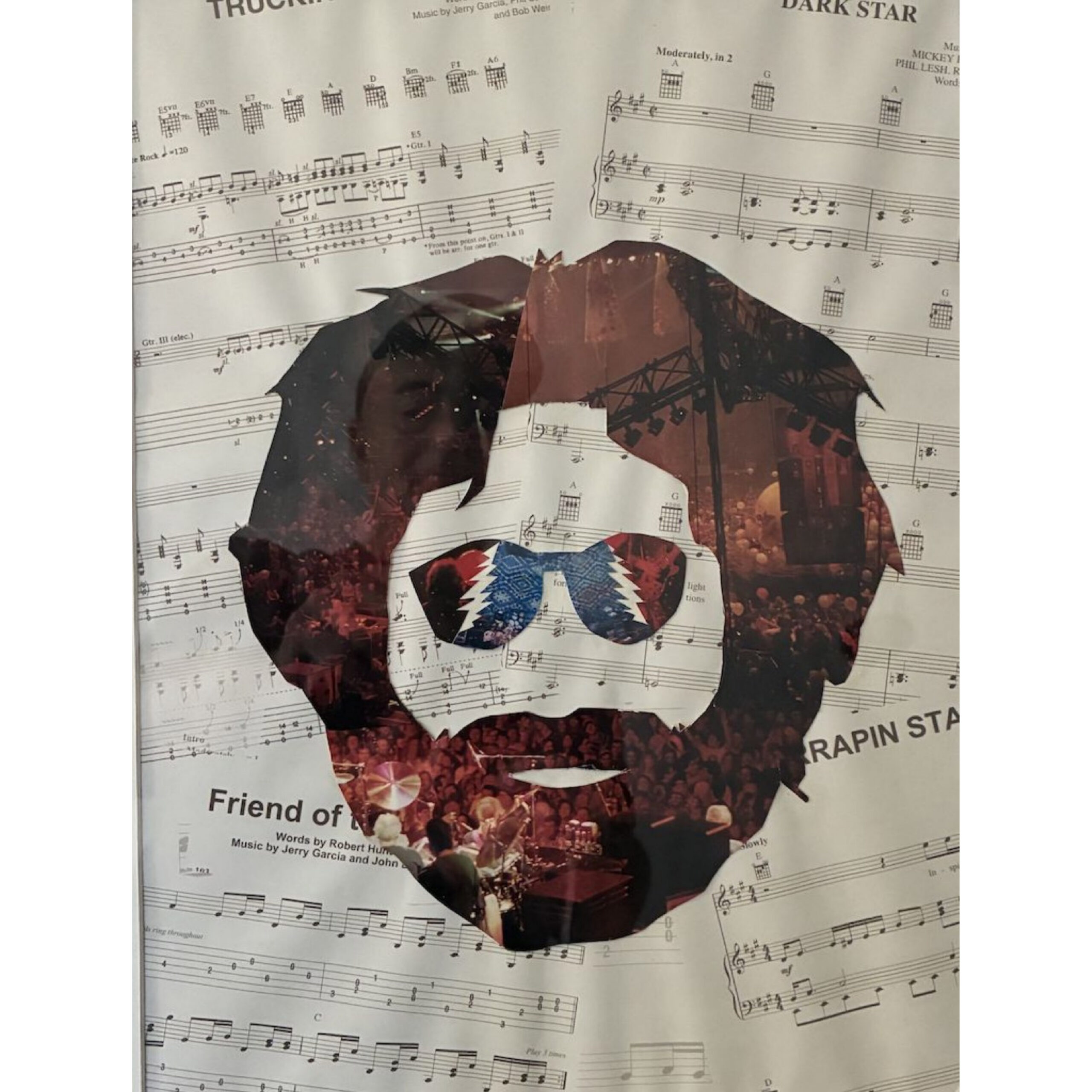
A portrait silhouette of Jerry Garcia, drawn not with lines but with people. The hair and beard are filled with concert photography — crowds, lights, and the glow of the stage. In Friend of the Crowd, concert photography forms the dark mass of Jerry Garcia’s hair and beard. The silhouette is immediately recognizable, yet its interior reveals an audience, stage structures, and the atmosphere of live performance. Red, white, and blue lightning imagery in the sunglasses supplies a concentrated accent at the center. The open areas of the face remain filled with music. Sheet-music passages continue through the facial space and around the head, making the background an active part of the portrait. The visible Friend of the Devil score provides a direct connection between the depicted musician and the material surrounding him. The combination offers a moving interpretation of the relationship between a performer and an audience. Garcia’s likeness is assembled from images of the shared event, suggesting that a musician’s cultural presence also lives in the people who gather to listen. The portrait’s clarity from a distance gives way to a more collective image as the viewer moves closer.
- Negative space: The face itself is left open, so the sheet music behind it shows through. The likeness is defined as much by what is missing as by what is there.
- The focal point: Sunglasses carry red, white, and blue lightning imagery — the brightest note against a subdued, smoky palette.
- The title: The background includes the score for Friend of the Devil; the artwork’s title gently rewrites it.
- Two readings: From a distance the portrait reads with immediate clarity; up close, it becomes a gathering of faces and shared experience.
Interpretation: The performer is literally made of his audience. It is hard to think of a more fitting portrait for a musician whose community of fans became part of the legend.
Connections Across the Works
Across the selection, Weinstein chooses materials that belong to the world of his subject. Comic characters contribute the colors of a flag; concert images help construct a musician’s face; musical notation surrounds an object named for that musician. This relationship gives the collage more than visual complexity: its component parts carry associations that deepen the finished image. The source material tells one story up close and helps tell another from across the room. The five works vary in how they organize that encounter. The flags use a fixed geometry to gather many small narratives. The two Garcia pieces place a strong central silhouette against a field of musical notation. Fab Four Ever expands into a busier panorama of lettering and London imagery. These differences keep nostalgia specific, connecting each familiar subject to a distinct arrangement of color, scale, and memory. Seen together, the five collages share a method and a memory, while each finds its own mood.
- The subject is the material. Comic heroes from comics, the Beatles from Beatles photographs, the Dead from Dead photography and songbooks. Weinstein’s source is never incidental; it is the meaning.
- Two flags, two temperaments. Spider Spangled Banner is about courage and action; Betty & Veronica Chronicles is about friendship and devotion. Swapping stars for heroes in one and hearts in the other, he shows how much a single symbol can hold.
- Archive and color. Black-and-white newsprint stripes, monochrome Beatles photographs, and printed sheet music recur throughout, always set against saturated pop color.
- A pair of Deadhead companions. Cherry Garcia and Friend of the Crowd share the same sheet-music ground and framing. One celebrates a flavor; the other, a face.
- Big statements, intimate asides. Three large panels command a wall, while the two framed Grateful Dead pieces invite a closer, quieter look.
- Childhood as a compass. Archie comics, Marvel heroes, the Beatles, the Dead — these are the icons of a 1970s kid, gathered by an artist who says he is saving pieces of his childhood.
In Weinstein’s hands, nostalgia isn’t a filter — it is the raw material.
See Greg Weinstein in Person
Hand-cut collage is an art of the close look. Photographs show the icon; only standing in front of the work reveals the thousands of cuts, the texture of old newsprint, and the stories hidden in every stripe. Explore these five works at The HUB Bridgehampton Art Gallery, where close viewing reveals the hand-cut edges, printed details, and connections within each composition. Browse the complete collection, follow the individual artwork links, or contact The HUB to inquire about a particular piece.
Location: The HUB, 2183 Montauk Highway, Bridgehampton, NY 11932
Hours: 10:00 a.m. – 6:00 p.m., Closed Monday-Tuesdays
Admission: Complimentary
Inquire About Greg Weinstein Artwork →
Explore the Full Collection →
The collection at a glance
- Spider Spangled Banner $8,240
- Betty & Veronica Chronicles $8,240
- Fab Four Ever $8,240
- Cherry Garcia: A Pint of View $2,575
- Friend of the Crowd $2,575
Learn more about the artist and his process at gregweinstein.art.