
The HUB Bridgehampton Gallery · Artist Spotlight
Faris Saleh Fine Art Designs: Shells, Blossoms, And Sculptural Shore Life

Five works bring the ocean’s textures into an imagined world of gardens, branching forms, and sculptural adornment — trnasforming discarded oyster shells into plumage, meadows, winter branches, desert blooms, and a hat fit for the tide.
Most oyster shells end their story on a plate. In the hands of Faris Saleh, they begin a second one. Within that seasonal frame, Saleh contributes something distinctive: the sea itself, gathered up and replanted as a garden. An oyster shell carries its own drawing: a ridged exterior, an irregular edge, an interior that catches and softens the light. In Faris Saleh’s artwork at The HUB Bridgehampton Art Gallery, those qualities become the starting point for compositions that reward a slower look. The five works featured here — Osprey, Sunset Prairies, The Snow Stone Floral Seaweed, The Double Floral Sea Cactus, and Oyster Hat — are built from rough, layered oyster shells, most of them set with pearls and bound in resin. Up close, every shell keeps its own ridges, chips, and weathered color. Step back, and those same shells become feathers, petals, snowy branches, or the crown of a brimmed hat. The collection sits somewhere between relief sculpture, assemblage, and botanical fantasy. Three of the wall works list depths of 8 to 9 inches, so they shift with every step you take and every change in the light. Photographs flatten them; the gallery floor and your home does not. Across the five featured pieces, shells gather into dense reliefs, open like flowers, climb along driftwood, and surround the crown of a hat. The palette moves through ivory, weathered gray, warm brown, and the occasional blue-green accent. What gives the works their variety is the way each arrangement handles space: crowded or airy, contained or reaching beyond its frame. Saleh’s work offers a tactile connection to the coastal setting of Bridgehampton and a distinctive approach to transforming nature.
Explore Faris Saleh at The HUB →

The Artist’s Creative Approach
Faris Saleh is a self-taught artist whose path to sculpture ran through performance. Before turning to shells, he worked as an actor and model in New York City, Los Angeles, Miami, and Europe. His studies span anthropology, drama, psychology, sociology, music, and art. His artist biography credits that mix with shaping how he approaches emotion, movement, and storytelling — qualities that surface in the way his shells seem to rise, swirl, and open. His central material has a personal origin: discarded oyster shells collected during family gatherings. Today Saleh divides his time between the Hamptons and Florida, drawing on the rhythms of the ocean, natural light, and coastal materials. The gallery’s notes point to a method built on repetition and placement. Saleh lets each shell’s natural variation guide the composition, then gathers many small, irregular forms into a larger rhythm. In several works the shells spill past the frame, so the piece seems to keep growing into the room. That background provides a useful way into these works. The materials retain the marks and irregularities that make them recognizable. Saleh’s contribution becomes visible in the choices of placement, orientation, repetition, and spacing: how one curved shell meets another, where a cluster thickens, and when an open area allows a form to stand apart. Materials utilized:
- Oyster shells — the primary building block, left in their natural cream, sand, honey, gray, and brown tones
- Driftwood, seaweed, and paint, which join the shells in The Snow Stone Floral Seaweed
- Resin, which binds the assemblage and enriches its surface
- Pearls, including the rose pearls of Sunset Prairies
- Canvas and wood frames as grounds
The shell’s natural shape becomes part of the composition’s structure.
A Closer Look at the Featured Works
01 / Sculptural Relief
Osprey — A Coastline Written in Plumage & Surface Built from Overlap
Materials: Oyster shells, pearl, and resin on canvas
Dimensions: 21 × 20 × 8 inches
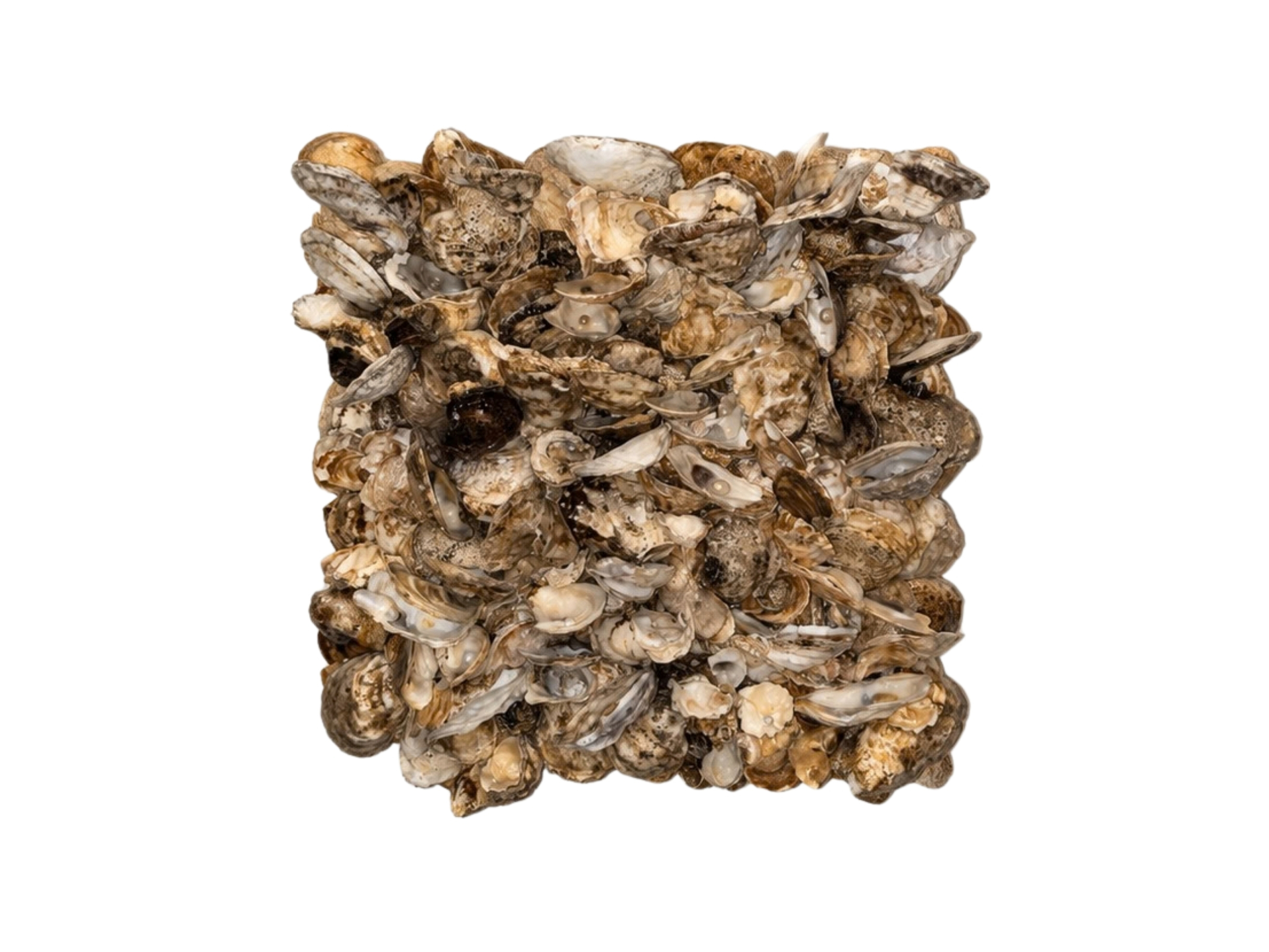
Osprey is the most densely packed of the featured wall works. Oyster shells overlap across the surface in a compact arrangement of projecting edges, rounded cavities, and dark recesses. Cream and gray meet deeper brown tones, creating a visual rhythm through differences already present in the material. The shells’ changing orientations are central to the piece. An open interior receives light differently from a rough exterior; an edge turned sideways creates a sharper line. Together, these decisions give the relief a surface that can feel almost feathered. The title makes an association with coastal birdlife possible, although the composition also invites readings of reef formations or accumulated shoreline fragments. Its eight-inch depth gives the work a substantial presence beyond the canvas. Viewing it from an angle reveals how much of its character comes from the spaces between shells—small intervals that become pockets of shadow.
- Technique: Shells are set at deliberately varied angles. Some open toward the viewer; others turn on their sides, forming a terrain of ridges, hollows, and projecting edges.
- Light: Those sideways shells create small pockets of shadow. As light moves across the surface, the contrast between rough exteriors and smoother, pearlier interiors comes forward.
- Structure: At 21 by 20 inches, the format is nearly square, so no single direction dominates. The eye wanders the surface the way it might scan a tide line.
- What sets it apart: It is the one work here with no floral reference. Saleh lets the massed shell speak as pure texture.
Interpretation: The title points to the osprey, the fish-hunting hawk of the coast. The layered shells can be read as overlapping feathers — or as a shoreline deposit, or the architecture of a reef. The title leaves all three readings open.
02 / Floral Assemblage
Sunset Prairies, 2025 — A Shell & Pearl Meadow That Outgrows Its Frame
Materials: Oyster shells, rose pearls, resin, and wood frame
Dimensions: 23 × 20 × 8 inches
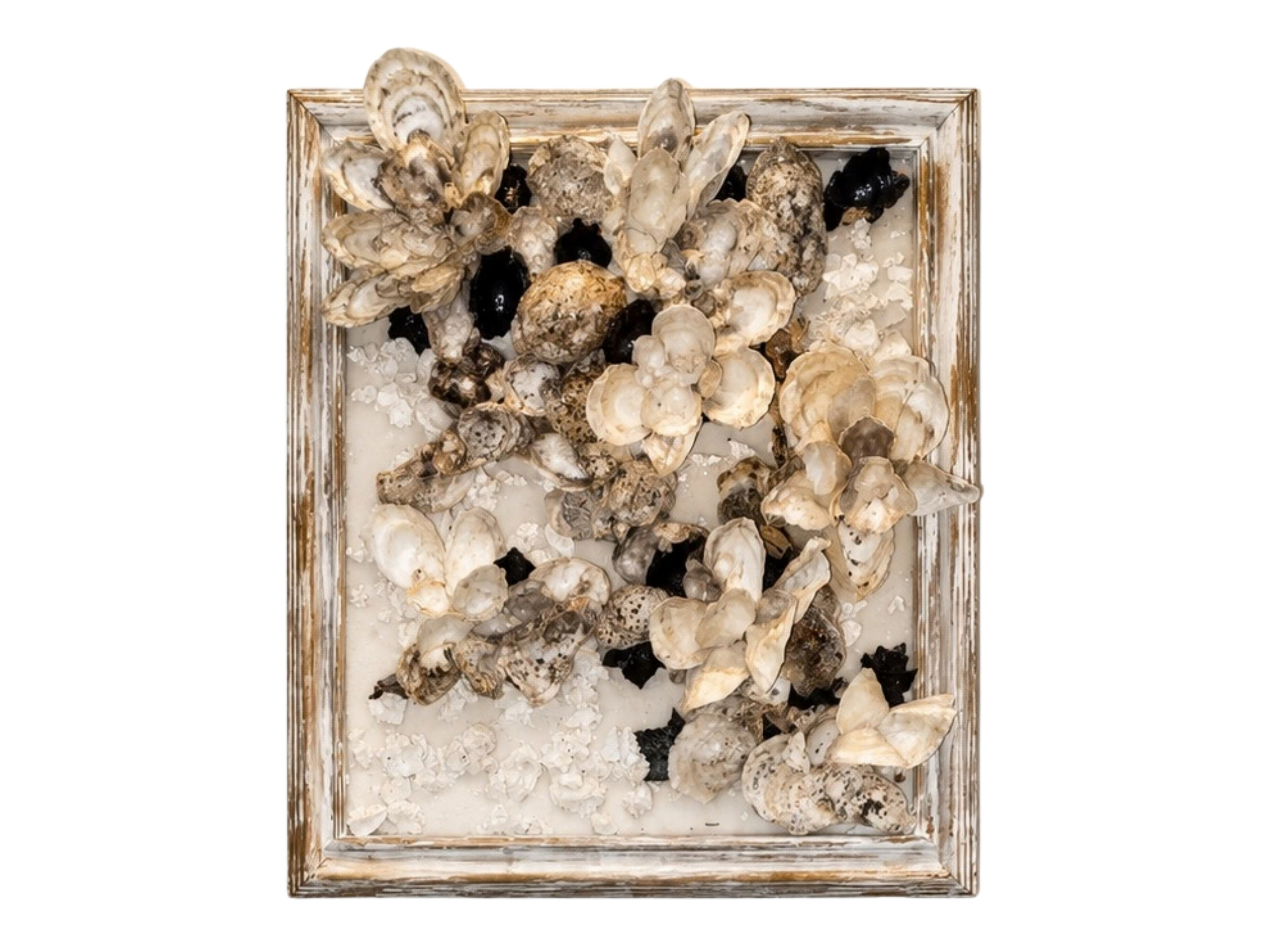
In Sunset Prairies, the shell clusters become more distinctly floral. Open shells radiate like petals, gathering into blossoms across a pale ground. Honey, cream, and weathered brown suggest warmth, while darker interruptions keep the composition from becoming uniformly delicate. The wood frame establishes a rectangular boundary, but several forms appear to press against or extend across it. This relationship gives the arrangement a sense of expansion: the blossoms seem to grow toward the edges of their setting. Smaller details fill some passages, while open areas let individual flowers retain their outlines. The title invites an imaginative connection between marine material and a meadow in evening light. That reading is supported by the warm palette and spreading floral rhythm. The shells still show their ridges and uneven contours, allowing the viewer to move between recognizing a blossom and noticing the separate elements from which it is built.
- Palette: Cream and honey tones lead, mingled with weathered gray and brown. Darker accents punctuate the pale ground, giving the eye places to rest.
- Materials: Rose pearls and resin enrich the assemblage. A wood frame with a muted finish echoes the natural palette rather than competing with it.
- Composition: Raised clusters reach toward and across the border. The bloom appears to exceed its setting — the first sign of a gesture that recurs across these works.
- Light and shadow: Light catches the shells’ smooth interiors and settles into the gaps between them, setting up a steady rhythm of bloom and shadow.
Interpretation: The title imagines an inland landscape at dusk, built entirely from ocean material. That crossing — shore becoming meadow — gives the piece its quiet wit, and the warmth of the rose pearls can be read as the last light of evening.
03 / Branching Composition
The Snow Stone Floral Seaweed, 2025 — Branches Beyond the Frame
Materials: Oyster shells, pearl, driftwood, seaweed, paint, and resin on canvas
Dimensions: 24 × 36 × 9 inches
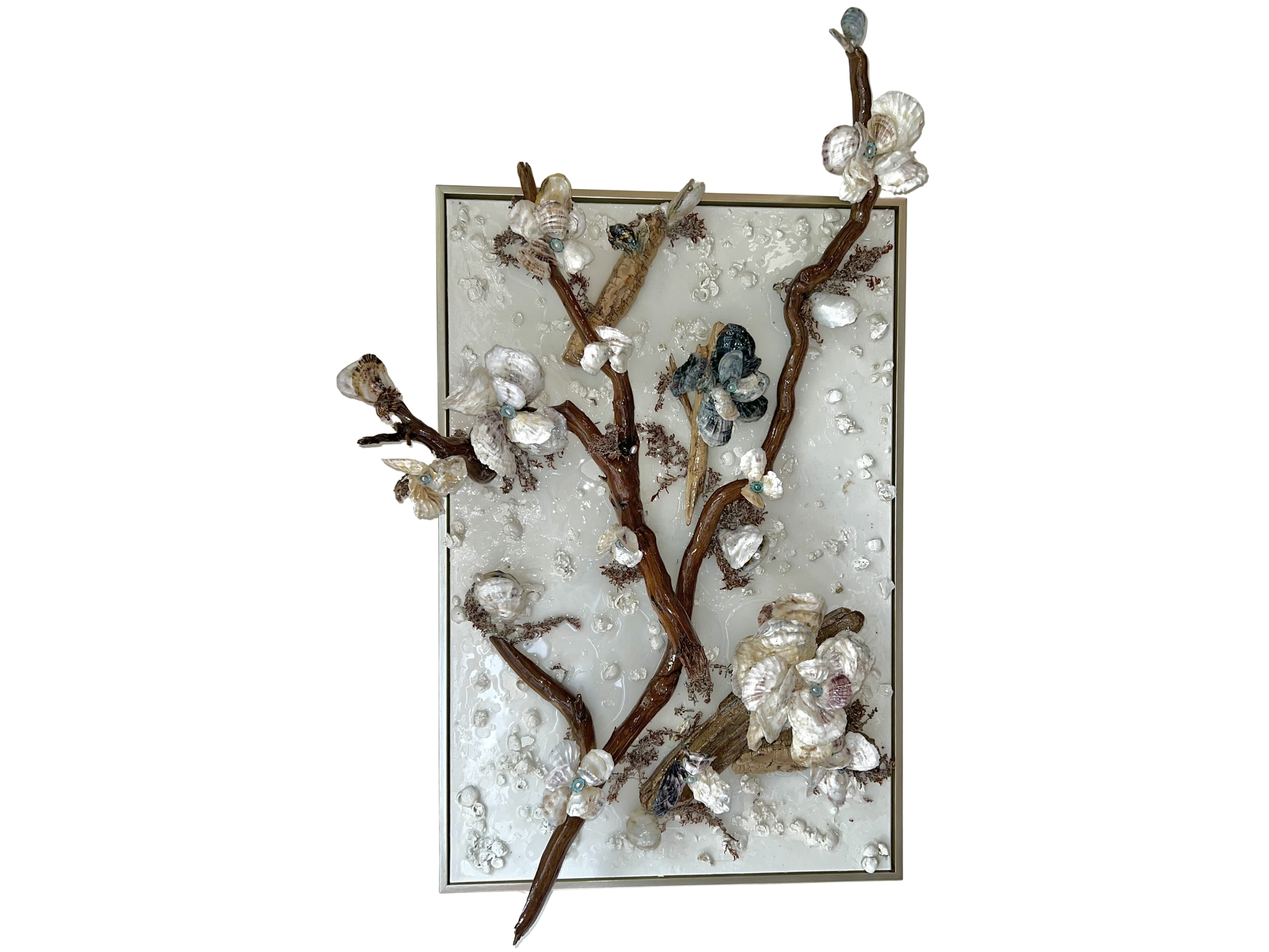
This tall composition finds its structure in winding driftwood. Dark branches travel across the pale canvas, carrying shell blossoms at intervals and extending beyond the frame. Their directional movement draws the eye upward, outward, and back through the work. Compared with the density of Osprey, the arrangement gives more space to each gesture. The exposed background makes the branching lines easy to follow, while scattered pale details keep that space visually active. A blue-toned flower introduces a cool focal point among the ivory and gray surfaces. The contrast between dark wood and luminous shell can suggest a winter garden: weathered branches bearing improbable blooms. This is an interpretive possibility encouraged by the work’s pale field and title. Its physical structure remains equally compelling, with the frame providing a point of reference for forms that continue beyond its edges.
- Materials: This piece has the widest material range of the five. Driftwood, seaweed, and paint join the shells, pearls, and resin.
- Composition: The driftwood gives Saleh something the other works build only from massed shells — a drawn, continuous line. The branches break past the frame at several points, and its 9-inch depth is the greatest listed among the wall works.
- Color: Ivory and silver-gray shells glow against the weathered wood. A single blue-toned flower near the center becomes the accent the eye keeps returning to.
- Balance: Scattered pale forms across the background answer the strong movement of the wood with a lighter rhythm of smaller elements.
Interpretation: Weathered branches and luminous shells together suggest an imagined winter garden. It is a fitting note for an exhibition built around the turn of the seasons — the shoreline pictured in the months when it rests.
The largest and most ambitious work in the group is also the one with the strongest line. A dark, winding length of driftwood rises across a pale canvas, carrying oyster-shell blossoms along its path like a flowering branch held against snow.Check-Out The Snow Stone Floral Seaweed →
04 / Botanical Relief
The Double Floral Sea Cactus, 2025 — A Compact Garden of Forms
Materials: Oyster shells, pearls, and resin on canvas with a wood frame
Dimensions: 16 × 16 inches
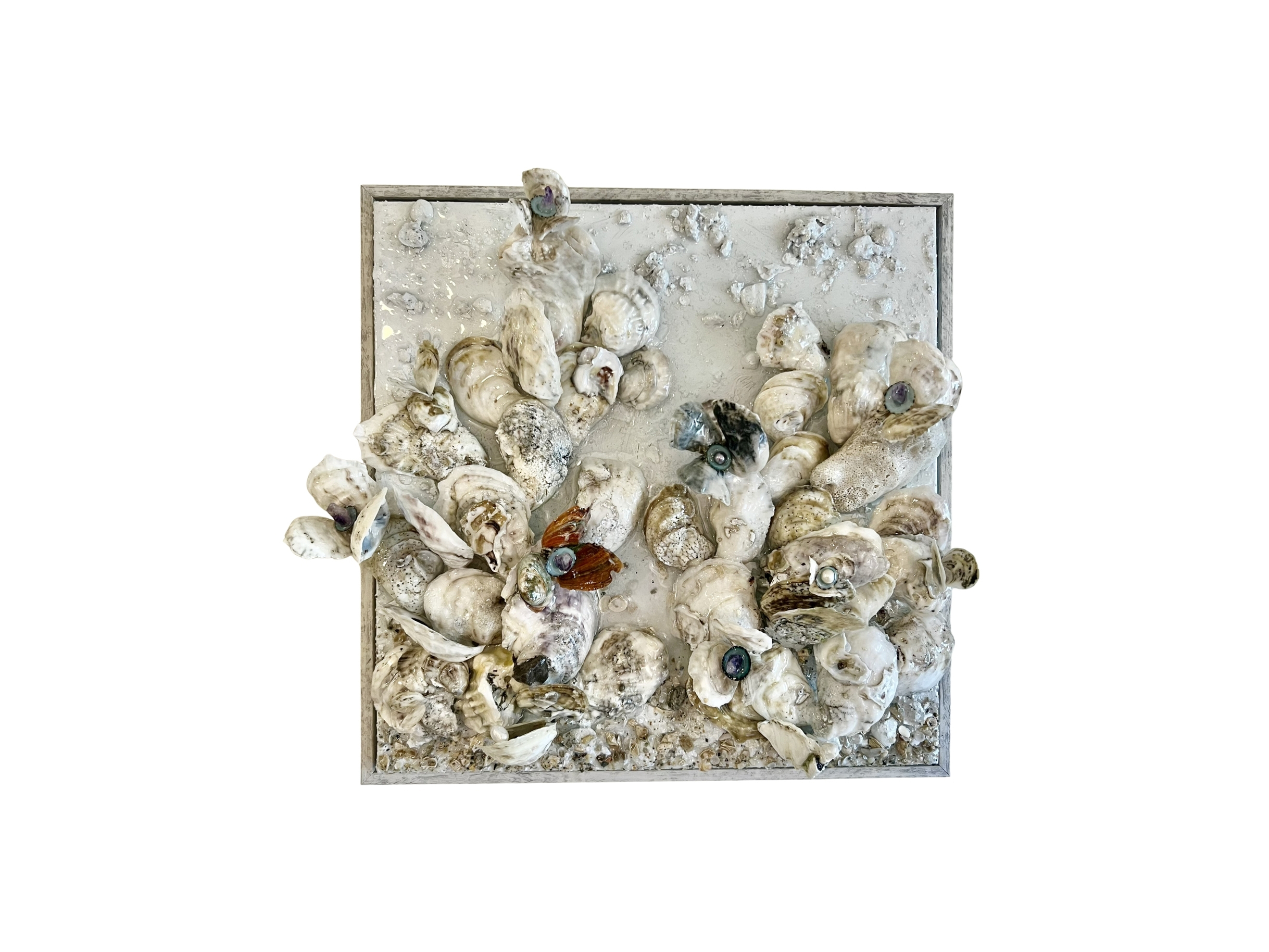
Within a square format, The Double Floral Sea Cactus develops a different kind of botanical rhythm. Shells accumulate in branching clusters, their rounded and pointed shapes suggesting cactus growth and opening flowers. Pale tones unify the work, while blue-green and rust-colored accents draw attention to individual centers. The composition balances raised clusters with quieter areas of background. Those pauses matter: they allow the eye to distinguish one growth from another and give the arrangement a lightness despite the quantity of material. Several shells project beyond the frame, loosening the square’s strict outline. The resulting contrast between geometric support and irregular natural forms is especially clear at this intimate scale. A closer look reveals how rough shell backs, smoother interiors, and small pearl details create variety within a restrained palette.
- Palette: Ivory, gray, and muted brown set a soft coastal ground. Blue-green and rust-colored accents mark individual centers, like the heart of each bloom.
- Negative space: Open areas of background let the eye pause between denser clusters. Compared with Osprey, the surface breathes.
- Edges: Shells project beyond the wood frame, softening its strict geometry and giving a small format an expansive presence.
- Texture: Rough shell exteriors sit beside smooth interiors, and the work invites close looking at how each contributes to the whole.
Interpretation: Cactus and sea rarely meet. One reading is that both are survivors — forms shaped by salt, sun, and hard conditions — and Saleh’s imagined garden lets them share a single vocabulary.
05 / Sculptural Object
Oyster Hat — The Shore as Adornment
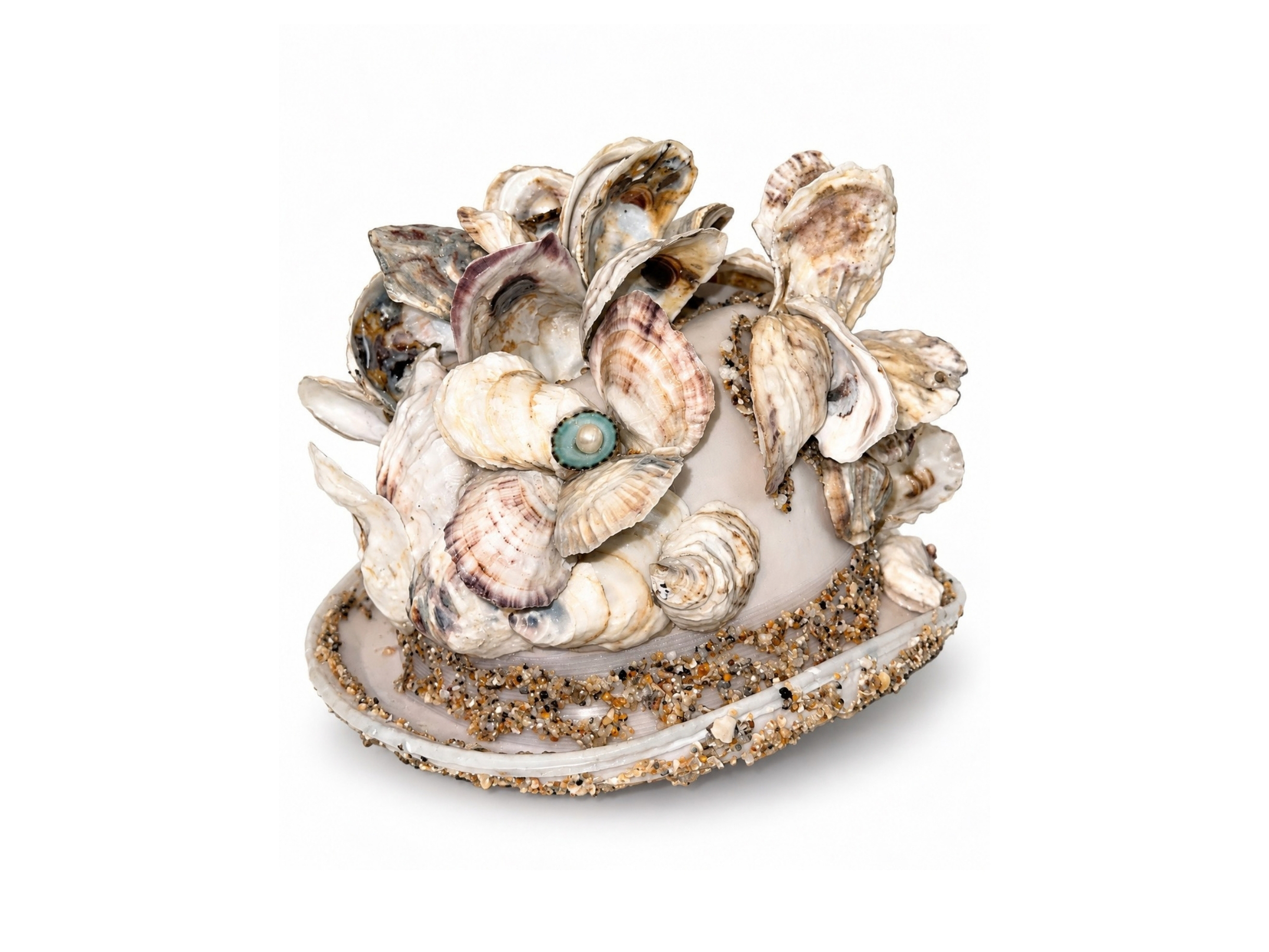
Oyster Hat takes Saleh’s shell arrangements into the rounded form of a familiar accessory. Clusters rise around the crown, their curved edges recalling petals or feathers. The pale hat remains visible between them, preserving the silhouette beneath the ornament. A turquoise accent provides a clear focal point at the front. Around the brim, bands of smaller fragments create a granular border, contrasting with the larger shells above. This shift in scale helps organize the object: expansive forms animate the crown, while finer details trace its base. The piece encourages viewing from several sides. Overlapping shells conceal and reveal different surfaces as the viewpoint changes, giving the arrangement a theatrical quality. Within this selection, the hat shows how the same material can move from a framed relief to an object associated with personal style—an imaginative meeting of coastal texture and adornment. The one fully three-dimensional object in the group, Oyster Hat takes Saleh’s approach off the wall and onto a form everyone recognizes.
- The crown: Oyster shells rise in overlapping clusters, their curved edges suggesting petals, feathers, and waves.
- The accent: A turquoise accent at the front creates a bright focal point — the strongest color note among cream, blush, gray, and brown.
- The brim: Bands of shell fragments trace its edge, turning a smooth outline into a granular, finely detailed one.
- Restraint: Areas of the pale hat stay visible between clusters, so the form holds its own against the abundance of ornament.
- In the round: The piece rewards a moving viewpoint. Each angle reveals different hollows, ridges, and layers.
Interpretation: Playful and theatrical, it joins personal adornment with marine assemblage. It is tempting to connect it to Saleh’s years in acting and modeling — a costume piece for the sea, built for presence as much as beauty.
Connections Across the Works
These pieces share a material vocabulary, yet each establishes a different relationship between density, direction, and open space. Osprey builds depth through accumulation. Sunset Prairies gathers shells into spreading blooms. The driftwood composition follows branching lines, while The Double Floral Sea Cactus concentrates its botanical suggestions within a square. Oyster Hat carries the exploration around a crown and brim. Light provides another connection. Because the surfaces project, overlap, and curve, illumination helps define their forms. Shadows separate individual elements; smoother interiors offer quieter highlights. The restrained colors keep attention on those changes in texture and depth. Seen together, the works reveal how much variety can emerge from sustained attention to a single material. A shell can act as a petal, a contour, a patch of light, or a fragment within a much larger structure.
- One material, many roles. The oyster shell plays feather in Osprey, petal in Sunset Prairies, blossom on a branch in The Snow Stone Floral Seaweed, cactus growth in The Double Floral Sea Cactus, and millinery ornament in Oyster Hat.
- The garden as a through-line. Two titles name flowers outright, a third sets its shells as blossoms, and the gallery’s notes find petals even in the curves of the hat. Together they plant an imagined garden of the sea.
- From contained to free. Osprey fills its canvas edge to edge. Sunset Prairies, The Double Floral Sea Cactus, and The Snow Stone Floral Seaweed let shells and branches cross their borders. Oyster Hat leaves the frame behind entirely.
- A shared palette, a single accent. Cream, gray, and brown anchor every piece. Most then add one distinct note — rose pearls, a blue flower, blue-green and rust centers, a turquoise accent — while Osprey stays purely earthen.
- Density and breath. Packed surfaces alternate with open ground across the group, giving the collection a rhythm of its own when the works are seen side by side.
- Borrowed landscapes. The titles travel far from the beach: a bird of prey, an inland prairie, a snowfall, a desert, a fashion accessory. The shore becomes a language for describing other places.
The common thread is transformation without disguise. Saleh changes what the shell becomes — never what it is.
Explore the Collection
Encounter Faris Saleh at The HUB
Discover the featured works at The HUB Art Gallery at 2183 Montauk Highway, Bridgehampton, New York. Spend time with the changing angles, raised surfaces, and small details that give each piece its character. Explore the collection online, follow an individual artwork’s check-out link, or contact The HUB for further information. Can’t make it to Bridgehampton? The full collection is available to browse/buy online too.
Explore Faris Saleh’s Collection →
Inquiries: +1 (631) 237-1356 · info@HUBHamptons.com
Location: The HUB, 2183 Montauk Highway, Bridgehampton, NY 11932